
Keynote speech by High Representative / Vice-President Kaja Kallas at the opening ceremony of the academic year 2025-2026, Victoria Amelina promotion, College of Europe
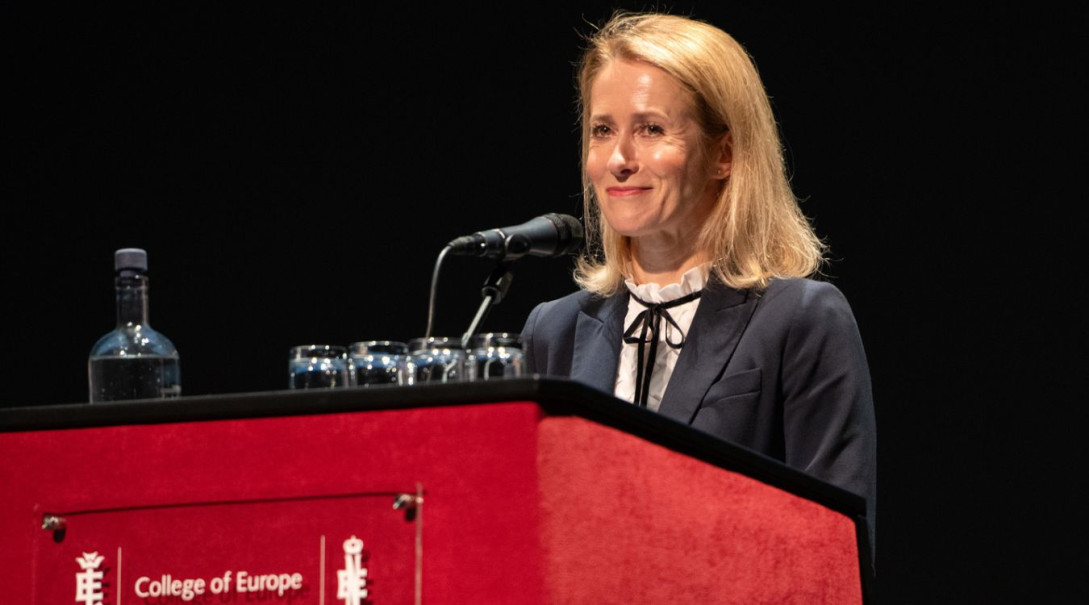
Dear Rector Mogherini (Federica),
Dear President Van Rompuy,
Dear Mayor De Fauw (mayor of Bruges),
Dear professors, staff members and guests,
And most of all, dear students and young diplomats,
It is my pleasure to speak at the opening of your academic year, for the College of Europe and the European Diplomatic Academy, which the College hosts.
If the College of Europe did not already exist, we would have to invent it. Your offer is unmatched on our continent: strong academic courses on three campuses, each with its own distinct academic and strategic identity. This has become one of your most important drawing points:
- Brugge with its focus on European law, politics and economics or ‘internal integration’;
- Tirana, for enlargement and the Western Balkans, or ‘future integration’;
- And Natolin, with its strength in the neighbourhood, security and geopolitics, or external strategy.
What the three have in common is quality: of the programmes, the instruction and the students. The EU is proud to co-fund the College and to locate our own Diplomatic Academy within its walls.
So let me first congratulate the Rector, the two Vice Rectors and the Board for a job well done over the years.
I am honoured that you have invited me to speak at your opening precisely this year, and for two reasons.
First, because this gives me the opportunity to pay homage to the fearless, gifted and compassionate woman, Victoria Amelina, after whom this year’s promotion takes its name.
Second, because this is also a chance to talk about a subject close to my heart, notably the importance of international law. Especially here in Europe. Especially now.
Victoria Amelina was an award-winning writer from the start of her literary career. Before Russia launched its full-scale invasion of Ukraine, Amelina penned two novels and one children’s book. But when the war began, her life took a radical turn.
In her book, ‘Looking at Women Looking at War’, she tells of her transformation from novelist to a documentalist, and I quote: “I’ve done this to uncover the truth…to ensure the survival of memory and to give justice and lasting peace a chance.” End of quote.
While some of her friends joined the army or trained as medics, Amelina joined an NGO called Truth Hounds that gathered evidence of war crimes. She wanted to do her bit for her country, the best way she knew how.
She wrote, and I quote: “(And) what weapon do we choose to pursue justice in the hardest times? A laptop, a camera, international law, storytelling power, or an M777 howitzer? No choice made by those who want true justice is easy, and for most of us, the outcome of our battle is still unknown.” End of quote.
Amelina wrote these words sometime in 2022. We know now the outcome of her own battle, in physical terms at least. Victoria Amelina died in July 2023 from injuries sustained in a Russian missile strike on civilian targets in Kramatorsk, Donetsk oblast.
The book I just quoted was published after her death. It is itself a testimony to the fact that the pursuit of justice is an individual choice but always a collective endeavour.
Dear students and young diplomats,
The key to lasting peace is the law. Amelina knew this. As a lawyer myself, that is what the European Union has always meant to me, the idea that international law, not violence, should govern the fate of countries and their people.
I am not here to give you a lecture on the law. You have professors who do that far better than I could. But let me put this into context.
International law is a broad area. Typically, it governs relations between states and international organisations. It encompasses treaties, trade, diplomacy, human rights, environmental law, maritime law and such. International law, writ large, is enforced mostly by state consent, international courts or diplomatic pressure. It is at the heart of free trade and of resolving disputes.
Under the umbrella of international law is international criminal law. Here we are talking not about states but about people. Individual accountability for decisions and actions related to the most serious crimes one could imagine: genocide, war crimes, crimes against humanity and crimes of aggression.
With aggression, what we are talking about is leadership crimes. Those who can commit such atrocities are those with the power to do so: heads of state and government, senior military or political leaders. Arguably, these are at the root of all other war crimes, because without a decision to attack another country followed up by troop deployments, most other war crimes could not take place.
The other categories of crimes under international criminal law target foot soldiers and mid-level commanders. To build a war crimes case against them requires evidence. This needs to be gathered in a way that is admissible in a court of law. You must follow specific protocols, uncover every aspect of an allegation, and document them in a specific way. This is where Victoria Amelina comes in.
Amelina, together with hundreds of others in Ukraine, carried out these investigations with vigour. She did this knowing that it might not amount to anything. The outcome of the war was unclear at the time of her death. It is still unclear today. But she did this in an effort to make the future a better place than her present.
In Syria, long before the fall of the Assad regime, the EU was also supporting individuals collecting evidence of the regime's atrocities, including proof of torture and other crimes committed in the infamous Sednaya prison. And I want to pay tribute here to Your Rector and my predecessor Federica Mogherini, who was personally behind these accountability efforts.
Whether we are talking about Ukraine, Gaza or Syria, the essence of international law is always its universal nature. Accountability cannot be selective or the entire system is in question. And we cannot afford to let this happen. Because the ultimate power of the law is simple: it is always a chance for progress.
Today’s assignment – if I may – I think we owe it to Amelina – is this: what can you do to make our future a better place than the present? I will give you some ideas by way of five observations.
First, the relationship between international law and power politics is a tense tango. At times, norms and strategic realities align. But just as often they clash. Sometimes the law puts the brakes on power and sometimes power violently bends the law.
In the case of Amelina’s Ukraine, if the law had worked, a permanent member of the UN Security Council would not have, could not have invaded its neighbour. It is against all international norms, including the UN Charter.
Consider how keenly some states are watching how the world behaves with Ukraine’s struggle. Since we know that violating the law without accountability tends to encourage others to do the same, this contagious effect is already reason to stand up for the law, even if your rights are not currently being violated.
The vast majority of countries are also small or medium-sized. And for them, international law is the only guarantor of a peaceful existence, a refuge from a world where might makes right.
On a personal note, I have my own experience in the outright abuse of the law. Last February, while I was still serving as Estonia’s Prime Minister, I was the first head of government to be put on the Russian Interior Ministry’s wanted list. Russia has always veiled its political repression behind so-called law enforcement agencies.
Second, international law is a human construct, not a principle of physics. As Friedrich Hayek wrote, “complex social systems emerge organically from individual actions, not central planning”.
Instead of reverting to that traditional counterargument that there is “no legal basis” for doing x, y or z—we can create those bases. For instance, the idea for the London Charter, which ultimately led to the Nuremberg trials after World War II, first came to light as early as 1942. The war raged on with no end yet in sight.
When I was practicing law, I wasn’t paid to say “no, can’t do that”. I was paid to come up with solutions. International law is not perfect and doesn’t solve all problems, but without it, we would sink into anarchy. So we need to develop it further.
And this brings me to my third observation: we can and we do come up with solutions if we choose to. The most recent example is the Special Tribunal for the Crime of Aggression against Ukraine. The International Criminal Court has the power to open a formal investigation on war crimes and if the evidence supports it and the judges authorise it, it can indict and prosecute.
But there was a gap. It does not have jurisdiction to prosecute the crime of aggression, leadership crimes. And so the idea of a special court was born. After a lot of work, it is now almost operational. When I was in Kyiv two weeks ago I announced 10 million euro of support to get the court up and running as soon as possible.
Which brings me to a fourth observation. As the ICC’s Registrar said at the Bled Security Forum where I was this summer – international law has never been more developed, more codified or more accessible.
There are encouraging signs that international law is growing. One example is the new Special Tribunal I just described. Another is that the growing number of parties to the International Criminal Court. Now it stands at 125 states from all regions of the world, with the recent accession of Armenia and Ukraine.
Yet another example came three weeks ago, when the UN Human Rights Council decided to set up an independent investigation to gather evidence on allegations of human rights violations in Afghanistan.
But eclipsing this positive news, is a fifth observation – the dangerous paradox we face today.
A broad assault is going on against the international legal order, human rights, internationally agreed norms, and the institutions we have established to enforce them. This includes the International Criminal Court – the ICC – which holds perpetrators of the world’s gravest crimes to account and gives victims a voice.
The European Unoin has a long and robust policy of support to the ICC. I quote from the relevant Council Conclusion: “the EU’s policy on the ICC is to advance universal support for the court, ensure its independence and counter threats to its effective functioning”.
On selective application, the EU has its flaws, too. One Member State has announced its intention to withdraw from the ICC, but all Member States are legally bound by decisions that are adopted by the Council. Including the Decision in support of the ICC and including in the case of a withdrawal.
At the highest level, we have made our stance known. Just last June, the President of the European Council Antonio Costa called the ICC “a cornerstone of international justice” while European Commission President von der Leyen reaffirmed the EU’s “full support” for the ICC and its officials.
In Brussels we are currently looking at all available options, including specific mitigating measures, for how we can make this support count for the ICC in its time of struggle.
Dear students and young diplomats,
Whenever I travel around the world for my work, I make it a point to sit down with young people. I do this to hear your views, and pass on some of my own, because the world will soon be in your hands. In many ways it already is, if you look at the power of Gen Z demonstrations around the world, at the influence of social media, at the fact that yours is the generation of digital natives. You did not start your life in analog like me!
So back to the question: What can you do to make our future a better place than the present?
From the observations I shared with you, I would derive the following ideas for action:
- Take an active stand in defence of international law in general and the ICC in particular.
- Develop the law further. It is in your hands to do so.
- And be creative, innovative, and responsive to new situations that arise.
You can all be Truth Hounds like Amelina. I am also thinking of examples like the small group of friends who investigated the global diamond trade. Their work, which gave us the term ‘blood diamond’, led to the Kimberly Process and produced a UN Resolution recognising the role of diamonds in fuelling conflict.
You have the benefit of a good education, including here from the College of Europe. So use it: define your aim, find allies, make things happen. Or, to quote Taylor Swift, “pledge allegiance to your hands, your team, your vibes.”
In the final chapter of her life, Victoria Amelina turned from prose to poetry. This was not planned, she said, but compelled by the war. She commented that the “reality of war eats up punctuation / the coherence of a subject.”
You, dear students and young diplomats, still have your punctuation. I advise liberal use of the question mark and the exclamation point!
Thank you.