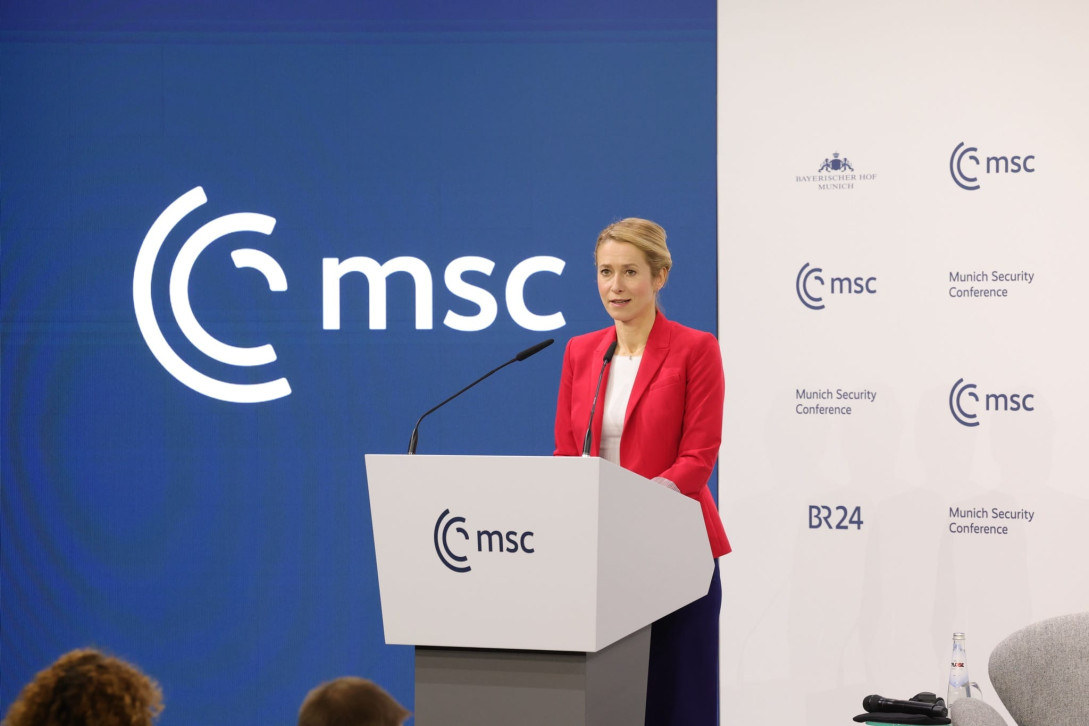
Keynote speech by HR/VP Kaja Kallas at the MSC: Europeans Assemble! Reclaiming Agency in a Rougher World
Dear Excellencies,
Dear Friends,
I want to start with some appreciation for the Marvel-inspired title of this panel: Europeans assemble!
And we are getting there, dusting off our capes, pulling on our boots, revving up our engines. Europeans also know what this fight is for: not only our excellent living standards, health and happiness, but the lessons we have learnt from our own history.
Contrary to what some may say, woke, decadent Europe is not facing civilisational erasure.
In fact, people still want to join our club. And not just fellow Europeans. When I was in Canada last year I was told that over 40 percent of Canadians have an interest in joining the EU! The waiting list is getting long. I just hope those who have been waiting for quite some time would not have to wait for longer.
As the polls show, those who are already Members want their Union to take a stronger role in the world: To defend our values. To take care of our people. To push humanity forwards.
As president Macron said in Davos, Europe is sometimes too slow, for sure, and needs to be reformed, for sure, but we absolutely know who we are and what we stand for.
But I agree there is a need to reclaim European agency. Three priorities.
First, Europe’s defence. This starts in Ukraine. But we know that Russia’s endgame is not the Donbas.
Beyond Ukraine, Russia already seeks to cripple economies through cyberattacks, disrupt satellites, sabotage undersea cables, fracture alliances with disinformation, coerce countries by weaponizing oil and gas. And of course there is also the nuclear threat.
I’m working now with President von der Leyen on a new security strategy to address all dimensions of European security, from hard security and defence to economic security and preparedness. Because in today’s world, security is indivisible.
But let’s be clear-eyed about Russia. Russia is no superpower.
After more than a decade of conflict, including 4 years of full-scale war in Ukraine, Russia has barely advanced beyond the 2014 lines. The cost? 1.2 million casualties.
Today, Russia is broken, its economy in shreds, it is disconnected from the European energy markets, and its own citizens are fleeing.
In fact the greatest threat Russia presents right now is that it gains more at the negotiation table than it has achieved on the battlefield.
And on the topic of negotiations, what matters more than having a seat at the table is knowing what to ask when you are sitting there.
And how I see it is simple: Russia’s maximalist demands cannot be met with a minimalist response.
Think about it:
- If Ukraine’s military is to be limited in size, Russia’s should be too;
- Where Russia has caused damage in Ukraine, Russia should pay,
- No amnesty for war crimes;
- Return of Ukrainian deported children.
This is really the very least Russia should agree to if peace is Russia’s goal. But as we suspect peace is not Russia’s goal, Europe is rearming and doing so together with our friends.
The second priority is stability in the European neighbourhood – East and South. This is where Europe has the most agency. Our priority here is enlargement, the antidote to Russian imperialism.
Since 1990, states that freed themselves from Soviet domination and joined the EU, have grown more than twice as fast as Russia. In 1990, Russians were twice as rich as Poles. Today, Poles are roughly 70% richer than Russians.
I also agree with historian Timothy Snyder who writes that European enlargement is vital for securing democracy and overcoming Europe’s own imperial history.
Today, enlargement is a geopolitical choice and we must say yes.
Our third priority is international partnerships.
Take trade for example. The European Union has built the largest free trade network in the world. Close to 80 countries are now covered by EU trade agreements.
On top of trade, we are creating partnerships on security and defence – 10 so far including India and Australia this year alone.
Countries want to diversify their partnerships to manage the risks of a rougher world, including the constant threat of tariffs.
They want to find joint solutions to digital challenges, from standards to semiconductors.
Because the vast majority of countries also want the same thing: stability, growth, and prosperity for their people. The best way to get there is to go together.
To conclude, we hear the call to action: Europeans assemble! And let me take more inspiration from the Marvel Universe: “Heroes are made by the paths they choose, not the powers they are graced with.”
Europe’s path is clear:
- Defend Europe
- Secure our neighbourhood
- And build our partnerships across the globe.
Thank you.