
Partnership in Training
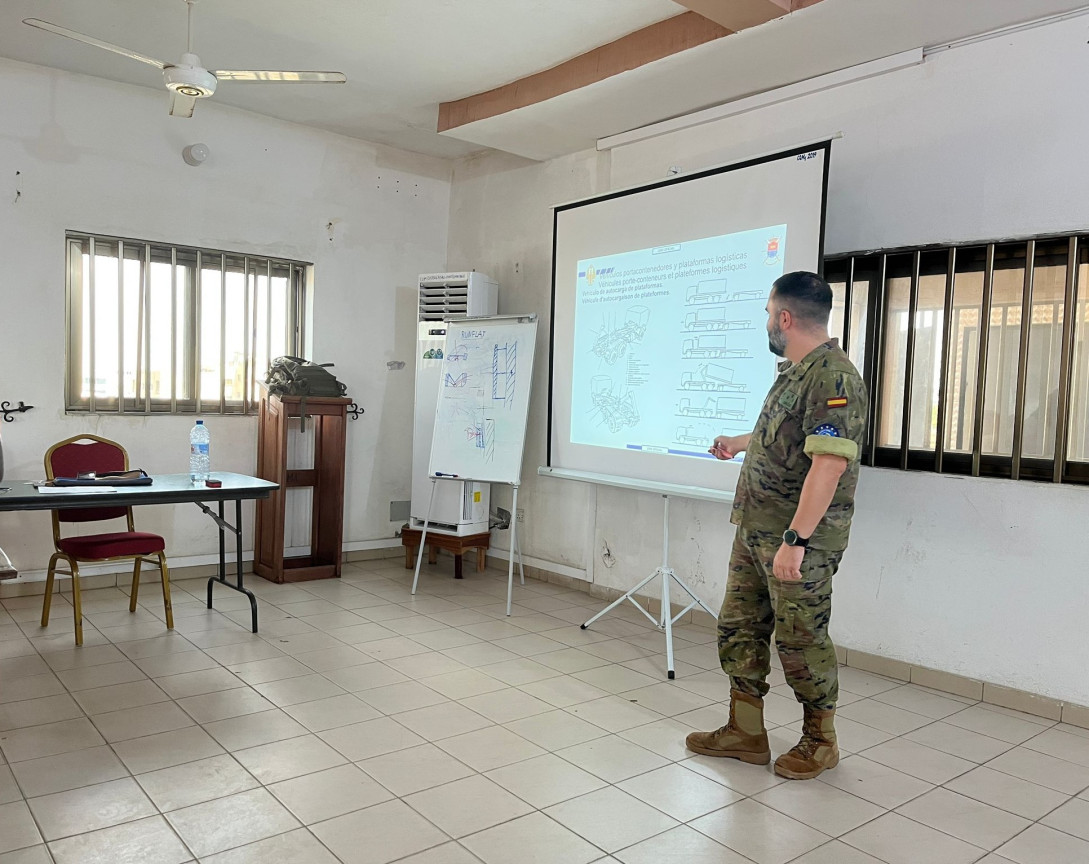
Following an intensive first week, the second week opened with a brief review of the material taught , ensuring a common foundation from which all participants could progress. This session smoothly transitioned into the completion of the module on the structure and functions of military workshops, where both instructors and trainees worked together to examine personnel organization and the tooling of armament, machinery, and vehicle workshops.
On Tuesday, the group jointly explored the fundamentals of electricity and basic electronics applied to military systems. The session generated substantial interest, with numerous questions demonstrating the constructive exchange between instructors and trainees. Wednesday continued this spirit of partnership as the trainees engaged in the classification of military vehicles—combat, tactical, and logistic—using examples from the Beninese Armed Forces fleet. The collaborative discussions reinforced the understanding of the principal systems that compose land vehicles.
On Thursday, the program advanced to a detailed study of military vehicle transmission systems. This session was further strengthened by the visit of the MILAD, Colonel Gastin, accompanied by his Benin counterpart from the General Directorate of Materiel. Their presence underscored institutional support and provided an opportunity for open dialogue between leadership, instructors, and trainees. The week concluded with the scheduled Block 1 assessment, conducted to evaluate collective progress and identify areas requiring additional reinforcement.
The third week built directly upon this cooperative foundation. At the start of the week, the team completed the module on vehicle transmission systems before jointly beginning the classification of ammunition, including both small-calibre and artillery rounds. The principles of operation of small arms and their basic maintenance were addressed with active engagement from all participants. Recognising gaps in prior knowledge, instructors introduced the topic of improvised explosive devices, providing practical case examples to enhance understanding and promote shared responsibility for safety.
The following days, instruction shifted to the principles and maintenance requirements of special equipment Throughout these activities, trainees and instructors continued to work in close partnership, ensuring that each system’s functions and maintenance procedures were clearly understood. A second progress test was scheduled for Friday, after which the module on military vehicle engines was set to begin.
In the fourth week, the cooperative efforts of the training team continued as the program concludes the remaining modules on military vehicle systems, addresses the safe handling and storage of ammunition, and introduces Class IX stock-management processes. These sessions are designed not only to reinforce technical competencies but also to strengthen the shared understanding of logistic procedures essential for effective maintenance operations.
Together, through sustained collaboration and mutual commitment, the training team and trainees built the technical capability and operational readiness of all participants.
EUSDI GoG
The EU Security and Defence Initiative in Support of West African Countries of the Gulf of Guinea (EU SDI GoG) is an EU initiative under the Common Security and Defence Policy. It brings together military and civilian experts to help Côte d’Ivoire, Ghana, Togo, and Benin enhance their security and defense capabilities, addressing security threats and preventing the spread of insecurity from the Sahel to the West African coastal states.