
EU Launches GEL 75 million (EUR 30 million) Programme to Assist Georgia reform its Public Administration
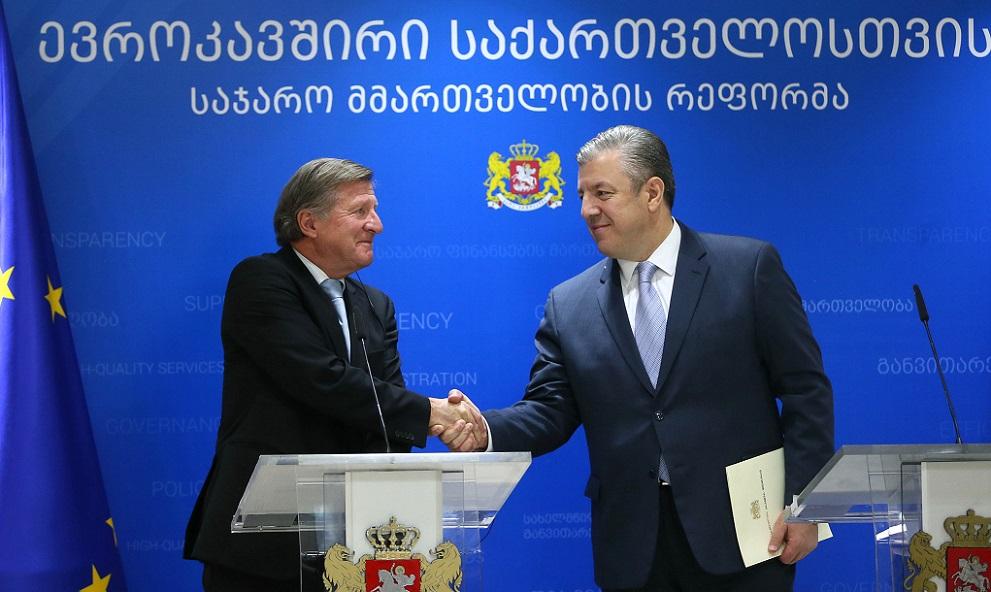
Tbilisi 28 October 2016: At a joint event today Georgian Prime Minister Giorgi Kvirikashvili and Ambassador of the European Union Janos Herman launched an EU-funded modernisation programme for Georgia's Public Administration.
"Good governance of public institutions is a cornerstone for democracy and economic development. It is also crucial for ensuring a population's trust in its state institutions. Georgia's national reform strategy is based upon the European Principles of Public Administration. The European Union is proud to both be a model and to support the Government's efforts in such an important area." noted Ambassador Herman.
With a total budget of GEL 75 million (EUR 30 million), the EU-funded support programme will be implemented from 2016 to 2019. Aligned to the priorities set by the EU – Georgia Association Agreement, DCFTA, and the Georgian National Public Administration Roadmap, the new programme targets five pillars:
1. Policy making: to ensure quality of the national policies and planning, including proper budgeting.
2. Professionalization of the civil service: to ensure public human resources management based on merit and transparency
3. Accountability and transparency of the public sector: to continue efforts of prevention of corruption in the sector and openness to the citizens and businesses
4. Accessibility of public services to citizens: in continuation of the already much-advanced changes.
5. Strengthening the structure of local governance, in support of the implementation of the Local Self-Government code and the decentralisation strategy.
The programme will primarily be implemented through support to the national budget (up to GEL 50 million/ EUR 20 million) and an additional GEL 25 million (EUR 10 million) will finance technical assistance to the Government, a Twinning programme to support civil service reforms and grants to civil society organisations active in areas covered by the programme.
The Administration of Government, under the Prime Minister, as coordinator of the Public Administration reform Roadmap, will have a leading role in the programme. The following ministries will directly benefit from technical support: Agriculture, Justice, Education and Science, Labour-Health and Social Affairs, Economy and Sustainable Development. The Civil Service Bureau will be strengthened to drive the implementation of the new standards of human resources management in the civil service and monitor the assets declarations of civil servants. Finally, the ability of civil society organisations to monitor government activities will be strengthened.
A more specific list of expected results is as follows:
1. Policy planning structures of pilot ministries (Agriculture, Economy and Sustainable development, Education and Science, Justice, Health) are strengthened, quality of monitoring and evaluation of selected sectoral strategies is increased (strategies for: Agriculture development, Small and medium enterprises, General education and science, Hepatitis C, Anti-corruption).
Linkage between planning and budgeting is increased (applied to all policy planning documents
2. Results-oriented management approach is introduced in the 5 pilot ministries (restructuration following functional reviews)
3. Legal framework of the civil service is adopted (2 laws on salaries and LEPLs, 12 regulations on classification, recruitment, appraisal, training etc… of civil servants)
Classification, remuneration, appraisal, systems are introduced, communication by the Government to the public on the reforms
Comprehensive civil service training system is established, with quality assurance standards introduced applied.
4. Accountability in the public sector is improved: effective monitoring of assets declarations of civil servants
5. Openness of the administration increased: adoption of the new Freedom of information law, improvement of the answers to request for information.
Improved accessibility of the public services to citizens at local level, increased number of community centres, municipalities using e-governance tools, users' satisfaction on the public services.
6. Improved strategic framework for local government reform in line with the European Charter on Local-Self Government;
7. Enhanced capacity of local civil servants for the formulation, coordination, management of local policies and public finances.
8. Civil Society Organisations more capable to engage and monitor Government activities
Background
Public administration reform is one of the three focal sectors of EU cooperation in Georgia. It represents 25% of the current EU-Georgia cooperation framework.
Georgia is committed, in the Association Agreement and DCFTA, to pursue its reforms of the central and local administration, including professionalization of the civil service, greater accountability and transparency of the public institutions and staff,. The Government of Georgia has adopted in 2015 the overarching Roadmap for the Reforms of the Public Administration, which encompasses the major priorities of reforms until 2020. The Roadmap is aligned with the European Principles of Public Administration.
In addition to this transversal programme, the EU has been providing support in specific PAR-related areas, such as:
- policy planning and coordination related to the implementation of the association agreement, with State Ministry of European and Euro-Atlantic integration
- Public finance policy reforms, with the Ministry of Finance
- Legal drafting and approximation with the Ministry of Justice Enhancement of service delivery with the public service Delivery Agency
- E-governance through twinning projects with Data Exchange Agency.
For additional information, please see: www.eeas.europa.eu/delegations/georgia
For more information, please contact: Delegation of the European Union to Georgia: Communications Manager, Mikolaj Bekasiak: