
G7 Foreign Ministers' Meeting in Italy, 10-11 April 2017 – extracts from the Joint Communiqué
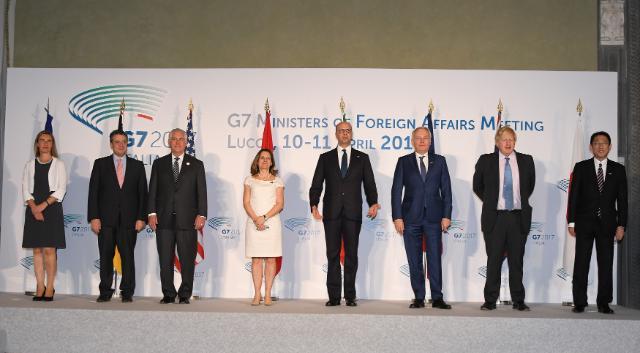
“We adopted common positions on all the main international issues in line with EU policies,” said Federica Mogherini, High Representative of the EU for foreign affairs and security policy and Vice-President of the European Commission, after two days of intensive talks.
The Joint Communiqué covers a number of international issues such as countering terrorism and violent extremism, Syria, Iraq, Libya, Africa, Yemen, Israeli-Palestinian conflict, Ukraine, Iran, Afghanistan, North Korea, non-proliferation and disarmament, outer space, maritime security, cyberspace security, peace and security in the framework of the UN, human rights and others.
Among other issues, the G7 Joint Communiqué also touches on the relations with Russia. To this end, it says:
"RUSSIA
We acknowledge that Russia is an important international player and that there are regional crises and global challenges that cannot be solved without cooperation with Russia. It is our mutual interest that Russia returns to the rules-based international security order and again becomes a cooperative partner. Upholding the principles of this order, we continue to use a wide array of foreign policy instruments, including restrictive measures. At the same time, we recognize that we have common interests with Russia in several areas, including countering terrorism and violent extremism in full respect of international law, confronting migration problems, fighting proliferation and finding answers to urgent environmental questions. We would welcome a constructive role by Russia in solving regional crises and unresolved regional questions. We underline our interest to engage individually and collectively with Russia in these areas and to actively look for ways to jointly address common challenges for the sake of more effective solutions. In addition, enhanced people-to-people contacts can form the basis for growing confidence in our bilateral and multilateral relations. We stand ready to intensify these contacts and call on Russia to allow for the necessary space by reversing its restrictive measures that limit the work of independent civil society and media.
Simultaneously, we also call on Russia to refrain from undermining or interfering in sovereign matters of other countries and consider such actions as highly detrimental to any future cooperation."
In addition, Russia's role and obligations are also underlined in Syria and Ukraine related contexts:
SYRIA
"We call on Russia and Iran, who have a responsibility, as allies of the Syrian regime, to use their influence to ensure Syria’s compliance with all of its obligations under the Chemical Weapons Convention."
"Russia has the potential to help resolve the conflict and restore a stable and unified Syria, and defeat ISIL/Da'esh and terrorism. We urge Russia to work to promote a real and genuine political process in Syria, in accordance with the Geneva communiqué and UN Security Council Resolution 2254, and to use its influence with the regime to bring the conflict to an end, beginning with the enforcement of a real ceasefire and improved humanitarian access, and engage seriously in the UN led political process. If Russia is prepared to use its influence, then we are prepared to work with it in resolving the conflict in Syria, pursuing a political settlement and ultimately contributing to the costs of stabilization and reconstruction."
UKRAINE
"We reiterate our condemnation of the illegal annexation of the Crimean peninsula by the Russian Federation and reaffirm our policy of non-recognition and sanctions against those involved. We are concerned at credible reports of a deteriorating human rights situation in Crimea and call on the Russian Federation to ensure the proper and unimpeded access of international human rights monitoring missions and human rights non-governmental organizations to Crimea."
"We urge all sides to take concrete steps that will lead to the complete ceasefire required under the Minsk Agreements. In particular, we expect Russia to live up to its commitments and to use its influence over the separatists to ensure they meet their obligations."
"We recognize the responsibility of the Russian Federation in the conflict in Ukraine and underline its subsequent pivotal role in restoring peace and stability in the country, by taking all necessary steps to improve the situation. Russia’s behaviour is not consistent with the rules-based international order, whose principles we are committed to protecting and upholding. We remain united in using a wide array of foreign policy tools, including restrictive measures and sanctions, with the goal of persuading Russia to return to a path of shared respect of those principles. We reiterate our call on all sides to assume their responsibilities and fulfil their commitments under the Minsk Agreements, including the withdrawal of foreign armed formations and equipment from the territory of Ukraine, the return of Ukrainian control over its side of the international border and safe access and provision of humanitarian assistance to people in need. We recall that the duration of sanctions is clearly linked to Russia’s complete implementation of its commitments in the Minsk Agreements and respect for Ukraine’s sovereignty."
Full text of the G7 Joint Communiqué