
Urban Refugees Ponder Challenges and the Freedom to Build a Better Life in a New UNHCR Film
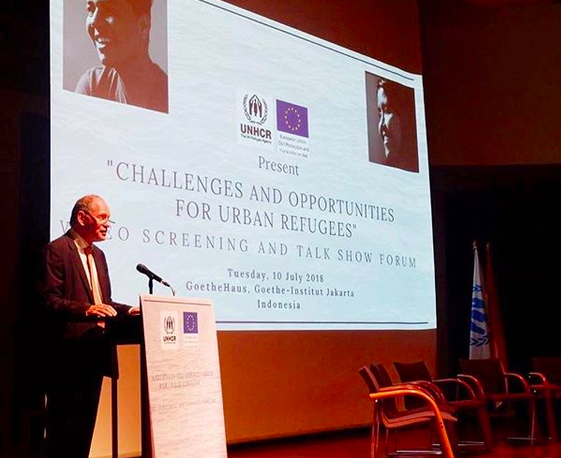
Mr Charles-Michel Geurts, Deputy Head of the EU Delegation to Indonesia welcomed guests to the premiere of a short documentary produced by UNHCR with funding from the EU. The film highlights the hopes and challenges faced by urban refugees in Jakarta, Bangkok and Kuala Lumpur. (Photo courtesy of UNHCR Indonesia)
Urban Refugees Ponder Challenges and the Freedom to Build a Better Life in a New UNHCR Film
Jakarta, 10 July 2018 – As Liaqat looks at the camera, he quietly notes, “everyone has hopes and dreams.” The compelling story he and his family tell are part of a short documentary film screened earlier today that highlights the challenges faced by urban refugees in Jakarta, as well as in Kuala Lumpur and Bangkok.
UNHCR, the UN Refugee Agency, produced the film and organised the screening at the Goethe-Institut Jakarta with funding the European Union's Humanitarian Aid and Civil Protection Operations (ECHO). A discussion on challenges and opportunities faced by urban refugees, particularly touching on detention policies in the region, followed the screening.
Liaqat’s family talked about their release from detention in Indonesia. This was possible thanks to a mechanism established by the Government of Indonesia that allows recognised refugees to be transferred from immigration detention centres to community shelters. It is a positive legal provision not found in other countries.
For more info, read UNHCR's press release. Click HERE
The Invisible Refugees of Indonesia, Malaysia and Thailand
In several countries across Southeast Asia, the absence of a proper legal framework for refugees means that they are often considered as 'illegal aliens', which puts them in a situation of extreme vulnerability. Indonesia, Malaysia, and Thailand are not signatory to the Refugee Convention and do not have specific laws for the protection of refugees. While the region’s economy is thriving and its population is booming, refugees and asylum seekers in these countries are forced into a life of invisibility.
In response to the rapidly growing number of asylum seekers and refugees in Southeast Asia, from 2017 to 2018 the European Union (EU) provided 1.8 million euro in humanitarian aid to enhance protection to vulnerable individuals in Thailand, Malaysia, and Indonesia.
Implemented by the United Nations Refugee Agency (UNHCR), the intervention focuses on the acceleration of the refugee status determination (RSD) process for asylum seekers and refugees in the three countries, with the aim to reduce the massive backlogs of pending RSD cases.
Here are three stories:
The invisible refugees of Indonesia: Liaqat and Rahilla from Pakistan
Liaqat, his sister Rahilla and their family arrived in Indonesia as refugees from Pakistan. They wanted to go somewhere safe but were detained in an immigration centre. "I felt that I was no longer human," Liaqat recounts. After two years, Laiqat's family was granted refugee status. Reflecting on the ordeal, Rahilla adds, "We're older than our years, we have become adults."
The Government of Indonesia and UNHCR are working together with the EU to find alternatives to detention.
The invisible refugees of Malaysia: Maheswari from Sri Lanka
Maheswary, her mother and her three children are refugees from Sri Lanka. "It's difficult to find full-time work when you're forbidden to work," Maheswary explains. Refugees in Malaysia have no legal status or right to work and often have to depend on informal work and donations.
With funding from the EU, UNHCR provides cash assistance to help Mashewary make ends meet, but with no right to work and her kids excluded from formal education, Mashewary asks how she can provide a better life for her family.
The invisible refugees of Thailand: Khadija from Afghanistan
"I didn't know we would come here and stay here. I didn't know that my children would face an uncertain future," says Khadija from Afghanistan. 'Here' is Thailand.
With support from EU, UNHCR has reduced the processing time for refugee status. Since Khadija was granted refugee status, she no longer feels "trapped" and her outlook on life has changed.
© UNHCR. All rights reserved. Licensed to the European Union under conditions.
More info:
EU Civil Protection and Humanitarian Aid Operations (ECHO)
UN Refugee Agency (UNHCR) in Indonesia, Malaysia and Thailand