
Speech by the Commissioner for climate action and energy Miguel Arias Cañete at the Tsinghua University: Explaining EU climate policy
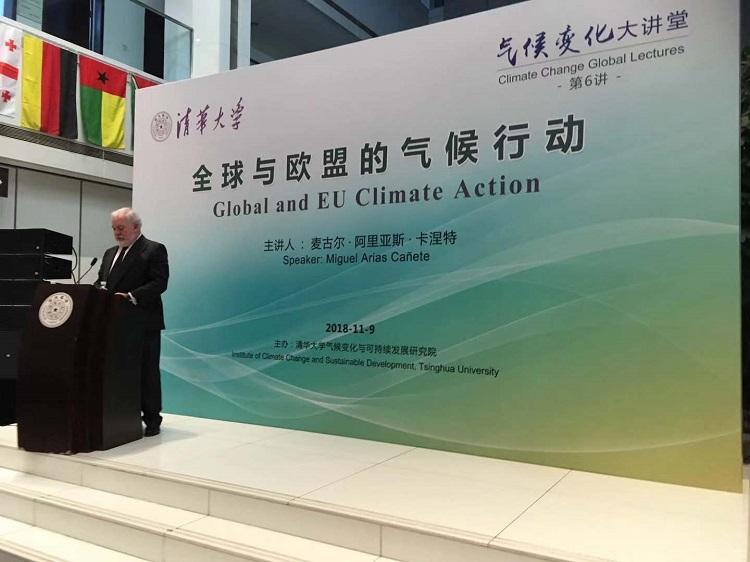
Beijing, 9 November 2018
Excellencies, distinguished guests, ladies and gentlemen,
Good afternoon, and thank you for inviting me to speak with you today.
It is an honour to address you here at this prestigious university, one of China’s finest institutions and known worldwide for its academic and research excellence.
And it is a pleasure to be back in China again – and back in this huge, exciting and fast-developing city, Beijing.
As European Commissioner for Climate Action and Energy, in the past few years I have had the privilege of working together with your country’s special representative on climate change, Xie Zhenhua, to move forward on climate action – in China, Europe and at international level.
Today, I am delighted to have this opportunity to explain the European Union’s climate policies. I will cover 3 key points:
First, what we have done so far, what are we doing currently, and what we have been able to learn;
Second, our plans and visions for the future;
And third, how we are cooperating with global partners on climate action, in particular with China.
I will then be happy to take your questions.
But first, it is necessary to understand why action on climate change is so important, and where we stand today.
In 2015, the world’s governments adopted the Paris Agreement on climate change, the first-ever universal and legally binding agreement to limit global warming, and deal with its dangerous impacts.
The Paris Agreement came after the world’s scientists concluded that global warming is definitely happening, and that human activity – notably greenhouse gas emissions from our economies and industries – is the key cause.
Now, three years later, global negotiations are taking place to make sure that the Paris Agreement is properly implemented. In December, we will gather in Poland, for the COP24 conference, where we hope to finalise the rules and guidelines to allow this.
And we now have a new global scientific assessment to guide our policy-making: a new special report by the Intergovernmental Panel on Climate Change, on limiting the global temperature increase to 1.5 degrees.
The IPCC report tells us that the 1.5 degrees would avoid some of the worst climate impacts, and reduce the likelihood of extreme weather events.
However, the report warns that the current climate commitments are not sufficient for achieving this goal.
The report shows that 1.5 degrees is achievable – as long as we act urgently, and use every tool at our disposal. So it is clear that we must work together and raise the collective global ambition.
I now come to the first main point I would like to share: the EU’s climate action so far, what we are doing for 2030, and what we have learned from our experience.
The EU has been at the forefront of climate action for two decades. Since 1990, we have created and implemented a range of policies to reduce our greenhouse gas emissions and transform our energy supply.
Our objective has been not only to reduce emissions, but also to move towards becoming a sustainable, low-carbon economy – in all sectors, and in all regions of Europe.
Currently, the European Union is implementing its 2020 climate and energy package. Agreed by EU leaders in 2007, this package has three key targets: (1) a 20% reduction of greenhouse gas emissions by 2020 compared to 1990, (2) a 20% share of renewable energies in overall EU energy consumption by 2020 and (3) increasing energy efficiency in the EU so as to achieve the objective of saving 20 % of the EU's energy consumption.
The 2020 climate and energy goals are part of a wider EU strategy for smart, sustainable and inclusive growth.
To achieve the 2020 target on greenhouse gas emissions, the EU is taking comprehensive action in all sectors of the economy.
An important tool is the EU Emissions Trading System, the world's first major carbon market. It is the EU's main policy for reducing emissions from large-scale facilities in the power and industry sectors, and aviation. Together, these sectors cover 45% of all EU greenhouse gas emissions.
The Emissions Trading System ensures cost-effective emission reductions, using a cap-and-trade system. There is a limit on the total amount of emission allowances, which decreases over time. And within the cap, companies receive or buy emission allowances, which they can trade.
In 2020, the target for the sectors covered by the Emissions Trading System, is to achieve 21% less emissions than in 2005.
Secondly, all EU Member States have 2020 targets for reducing emissions in sectors not covered by the Emissions Trading System.
These include transport, buildings, agriculture and waste, and account for 55% of total EU emissions.
Under this ‘Effort Sharing’ framework, all Member States have a national target, based on the principle of fair contribution due to each country’s economic strength.
Together, these national targets are to result in a 10% reduction in EU greenhouse gas emissions by 2020, compared to 2005.
Alongside the Emissions Trading System and Effort Sharing targets, the EU is supporting the development of low-carbon technologies, including with research funding under the ‘Horizon 2020’ programme.
Building on the 2020 targets, and to ensure progression towards our longer-term objectives, in 2014 EU leaders adopted a climate and energy framework for 2030.
For 2030, as part of this framework, the EU doubled its greenhouse gas emissions target: in 2030, the goal is to reduce emissions by at least 40%, compared to 1990.
This 2030 emissions target is also the basis of our commitment to the Paris Agreement – our nationally determined contribution.
And in the past few years, EU policymakers and legislators have worked intensely to adopt a set of modern regulations and support mechanisms, covering all sectors of the economy, so that we can achieve this target.
Firstly, we have agreed on a revision of the EU Emissions Trading System, so that it can successfully contribute to achieving the 2030 emissions target.
The revision includes an increase in the annual reductions of emissions allowances from 2021, and strengthening the Market Stability Reserve – a mechanism to reduce the surplus of allowances and make the system more resilient.
It also includes new actions to support industry and the power sector to make the low-carbon transition, including new funding mechanisms for low-carbon technologies.
One of the major new funding mechanisms is the creation of the Innovation fund: endowed with 450 million allowances, worth around 7 billion EUR in current carbon prices, to finance demonstration projects in low carbon innovation.
The modernised Emissions Trading system will allow the sectors covered to reduce their emissions by 43% by 2030 compared to 2005.
We have also agreed a new set of emissions targets for Member States for sectors not covered by the Emissions Trading System – new ‘Effort Sharing’ targets.
Building on the 2020 targets, all Member States have agreed new national goals for 2030, for emissions from transport, buildings, agriculture and waste.
Overall, the sectors covered by ‘Effort Sharing’ will reduce their emissions by 30% by 2030, compared to 2005.
Another important new measure agreed for 2030 is the inclusion of the land use and forestry sector in our climate framework.
Under this new legislation, EU Member States must ensure that greenhouse gas emissions from land use, land use change and forestry are balanced out by at least an equivalent removal of carbon dioxide from the atmosphere, over the period 2021 to 2030. We call it the ‘no-debit’ rule.
Other important action includes reducing emissions from road transport, a key source of emissions in Europe and worldwide. Ambitious proposals to cut emissions from cars, vans and large vehicles are now being negotiated.
And under the wider EU climate and energy framework for 2030, we have recently increased our targets on renewable energy and energy efficiency: we now aim to increase the share of renewable energy in the EU to 32% by 2030, and improve energy efficiency by at least 32.5%.
According to our estimations, this will in fact allow us to achieve higher greenhouse gas emission reductions than the 40% target.
Moreover, all Member States must adopt an integrated national energy and climate plan for 2030.
The EU wants to ensure an enabling environment to support the low-carbon transition. We aim to spend 25% of the next EU budget on climate-related action – and we have put forward an Action Plan on Sustainable Finance, to help reorient capital flows to sustainable investments.
We are also working to ensure our communities and economies are climate-resilient. Almost all EU Member States have a national adaptation strategy in place, and we are currently finalising an evaluation of the EU strategy.
This has been an overview of the EU’s climate action up to 2020, and our climate framework for 2030.
So has our action so far brought positive results? And what have we learned from our experiences in designing and implementing climate policies?
The answer to the first question is yes. The EU is on course to exceed its 2020 greenhouse gas emission reduction target of 20%:
By 2017, we had already reduced emissions by 22% from 1990. And during this period, the EU economy grew by 58%.
This shows clearly that that it is possible, and beneficial, to decouple emissions from economic growth. Reducing emissions can go hand-in-hand with economic prosperity.
And the benefits are not just economic. Climate action also makes communities more sustainable and resilient, helps preserve the environment, brings our citizens cleaner air and healthier living space.
Our experiences in designing and implementing climate policies have also shown us the importance of some key elements:
- Firstly, the importance of a strategic vision, agreed after detailed consultations with all stakeholders.
- Secondly, the need for regulations that cover all territories and all sectors of the economy – with necessary flexibilities and fair contributions from all operators.
- Thirdly, that regulations must be accompanied by support mechanisms and enabling policies in particular to boost private investments.
- And finally, the need for governance and monitoring progress. Here, the national energy and climate plans that all EU Member States must adopt are a very important addition to our climate framework.
I mentioned the importance of strategic vision – and this brings me to my second main point: the European Union’s future plans and visions on climate action.
The EU’s climate policies are designed with the longer-term in mind, and the global Paris Agreement has given the whole world a long-term objective on climate action.
And as I mentioned earlier, the world’s scientists have told us that that the world is facing an unprecedented challenge: We must lay foundations now, to achieve a carbon-neutral economy as soon as possible this century.
The EU has always aimed to be at the forefront of global climate action – and we want to lead the way in delivering on the Paris Agreement.
So, earlier this year, EU leaders called on the European Commission to prepare a proposal for a new EU long-term strategy for reducing greenhouse gas emissions.
The European Commission is working intensely on this, taking feedback from all stakeholders into account, as well as the IPCC special report on global warming of 1.5 degrees.
And we are planning to present our vision for this EU long-term strategy later this month, just before the COP24 climate conference in December.
Our objective is to enable the EU to reduce emissions in line with the long-term goals of the Paris Agreement, while making our economy more modern, competitive and resilient, as well as more socially fair for all Europeans.
Our proposal will be a comprehensive vision for the modernisation and transformation of our economy.
We will examine cost-efficient pathways to decarbonisation – including pathways that go towards zero net emissions by 2050.
We will not suggest one single preferred scenario or propose new legislation, but rather identify key milestones for the EU, allowing us to meet our commitments under the Paris Agreement.
The draft long-term strategy will take a comprehensive look at both supply and demand side of the economy. It will also explore the benefits of sectoral integration, especially strengthening links between energy and other sectors.
It will also provide insights for industry into the potential of various technologies, innovation and research needs, and scales of investment that will be required.
The important role of the land use and forestry sector will also be reflected, as well as impacts on energy security, air quality and competitiveness.
Of course, our draft strategy will only be a first step. It will lead to discussions across Europe about how we can move towards a fully decarbonised economy and society, as soon as possible this century.
Putting forward this proposal should allow EU Member States to agree on our long-term strategy and present it to our global partners by 2020 at the latest.
This will be a long-term strategy for reducing greenhouse gas emissions in the EU – but we also hope it will inspire our global partners to make similar long-term plans.
This bring me to my third and final main point here today: the European Union’s cooperation with our global partners on climate action, in particular China.
Firstly, I would like to reflect on the growing cooperation between China and the European Union over the past years and months.
China-EU cooperation on climate change has existed since 2005, when we began regular bilateral consultation meetings on climate change.
China and Europe both played an important role in securing the Paris Agreement in 2015. And I am pleased that we both remain fully committed to it.
At the China-EU Summit on 16 July here in Beijing, our leaders reaffirmed our commitment to advance with implementation of the Paris Agreement, and to increase our cooperation on climate change and clean energy.
Also at the summit, China and the EU signed a Memorandum of Understanding to enhance cooperation on emissions trading.
The EU Emissions Trading System was the first major carbon market to be established – and we have supported China in the development of its own emissions trading system, through a bilateral cooperation project.
We warmly welcomed the launch of China's nationwide carbon market in December 2017. We strongly believe the system will help China, the world's biggest emitter of greenhouse gas emissions, to mitigate emissions cost-effectively.
Further developing cooperation and sharing experiences between the world’s two largest emission trading systems is in our mutual interest, and can also help us to tackle common challenges.
More importantly, I trust that the positive example of China and the EU cooperating closely on emissions trading will be a powerful signal of leadership to other countries. This is particularly important now, with the retreat of the US.
So I am pleased that the Memorandum of Understanding establishes a policy dialogue, which could provide a useful platform to exchange views on relevant developments on emissions trading, and to explore forms of more comprehensive cooperation in the longer term.
On all areas of climate policy, the European Union is always willing to increase our cooperation even further, taking note that China has taken serious commitment and introduced vigorous policies to reduce its carbon emissions.
The university of Tsinghua is an important partner in this cooperation. I am very pleased with the good collaboration we have with the Tsinghua University’s School of Environment on emissions trading and the expert dialogues we have held on economic analysis and modelling for reaching the Paris Agreement goals.
Other interesting areas for exchanges between Europe and China include for example initiatives on low-carbon cities, linked to the Global Covenant of Mayors for Climate and Energy, and initiatives related to transport emissions, such as expert exchanges on the development of vehicle emissions standards.
Moving back to the Paris Agreement, the upcoming negotiations at the COP24 climate conference in December will be very important.
Notably, the parties to the Paris Agreement are aiming to finalise the ‘Paris Work Programme’ – detailed rules and guidelines rulebook for implementing the Agreement – at this conference.
In the leaders’ statement in July, China and the EU agreed on the importance of finalising the Paris Work Programme, so our cooperation will be as important as ever.
The COP24 conference will also bring the political phase of the ‘Talanoa Dialogue’ – a global process alongside the formal negotiations, to help countries implement and enhance their Paris Agreement commitments by 2020.
This open dialogue is a key moment for all Parties to examine their pledges.
The EU will play an active role in the Talanoa Dialogue – sharing our actions and experiences, and presenting our draft long-term strategy for reducing greenhouse gas emissions.
Since the Paris Agreement was adopted in 2015, the EU has increased its cooperation with partners all round the world – from other developed and emerging economies to the particularly vulnerable developing countries. In this context, we remain committed to scaling up the mobilisation of global climate finance.
Indeed, the EU collectively is the biggest provider of public climate finance to developing countries – we have doubled our total contribution in recent years, and overall it represents about 40% of all global public climate finance.
At the same time, while public climate finance is extremely important, achieving our global goals will require public and private investments to work hand in hand. This is why we are making ongoing efforts to enhance the broader mobilisation of public and private finance, both at EU level and through our support to partners.
It is clear that the goal of making finance flows consistent with a pathway towards low-emission, climate-resilient development is key for bringing about the transformational changes envisaged by the Paris Agreement – and all countries have a role to play in accelerating this transition.
Ladies and gentlemen, to conclude, I would like to highlight some key messages related to the EU’s experience from developing and implementing climate policies and our commitment to maintaining the global momentum for climate action.
The first is about moving forward, step by step, and keeping the ball rolling. This is how the EU has over the past two decades built up its climate policy framework that now spans all sectors of the economy and a vast array of policies, legislation and support tools.
The second is about the importance of a strategic vision. At EU level, we have translated our commitment to legally binding targets and measures for 2020 and 2030 and are now working on our long-term strategy. At global level, our efforts must be guided by our shared commitment to the goals of the Paris Agreement.
And the third message is about the power of cooperation. We have the best chance of success if we learn from each other and work together. I look forward to continuing on this path with China – a key partner for the EU.
Ladies and gentlemen, I would like to thank you for your attention – and I would be happy to take your questions concerning EU climate policy.
Thank you – Xie Xie.