
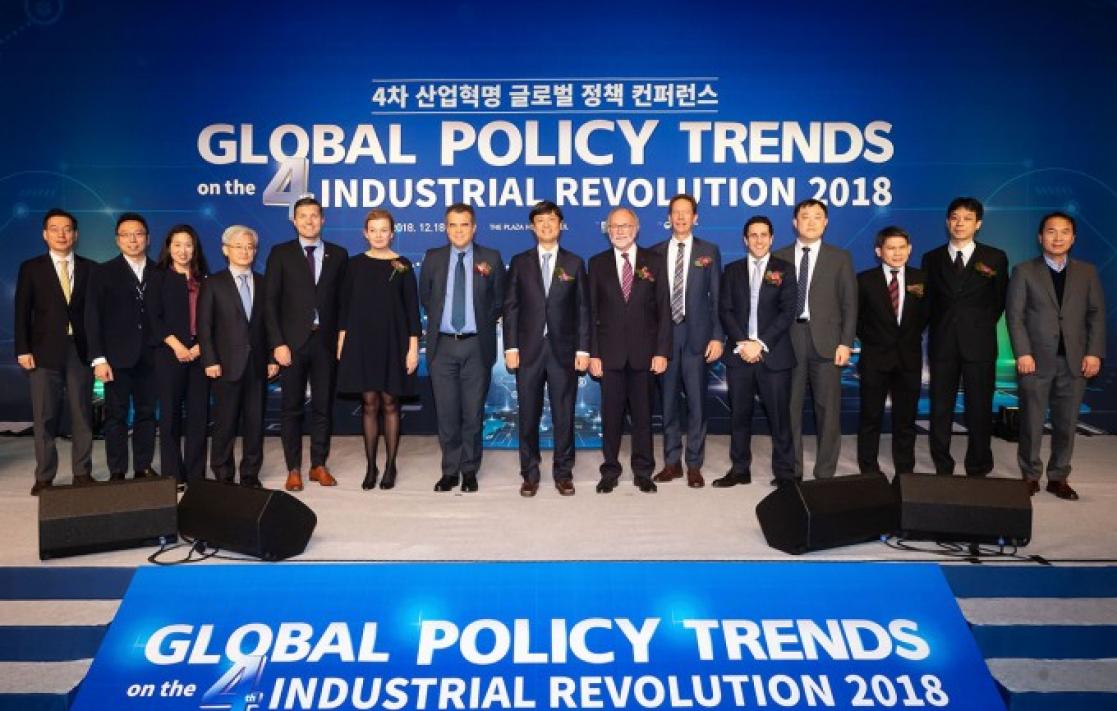
Keynote Speech at Global Policy Trends on 4th Industrial Revolution 2018

Dr Michael Reiterer
Ambassador of the European Union to the Republic of Korea
Keynote Speech at Global Policy Trends on the 4th Industrial Revolution 2018
10:20-10:50 (30') Tuesday, 18 December 2018
Grand Ballroom, The Plaza Hotel, Seoul, Korea
Distinguished Guests, Ladies and Gentlemen,
It is my great pleasure to deliver the first keynote speech in the Global Policy Trends on the 4th Industrial Revolution 2018 on behalf of the EU.
Before starting my presentation today, I would like to share with you a short video-clip from the film HER, which shows a genuine interaction and human-like relation between a man and software.
Only 5 years ago the movie “Her” looked like a product of cinematic imagination, but now it has become a tangible reality. Those who have seen the movie might share this impression. The movie sheds light on how technological developments affect our life, even our sentimental one! This is very well captured by what we are now used to call the “4th Industrial Revolution”.
[4th Industrial Revolution – General parts]
- There are several different definitions of the 4th Industrial Revolution, but the main features are undisputed. It has been driven over the last three decades by the IT revolution, which has already radically transformed our working and living environment. It is made possible by the enormous progress in miniaturization and the development of digital networks infrastructure, and by connecting powerful, autonomous microcomputers with each other and with the Internet.
- It is characterized by a fusion of new, powerful technologies, which overcomes the borders between the physical, digital, and biological world. It affects all disciplines, economies, industries, and of course also the society. This interconnection between several worlds is very powerful. At intersection of these worlds, there lies a new world, the “world of new opportunities”.
- The 4th Industrial Revolution is certainly not the first big change in human history, but it is unprecedented with respect to the speed of the transition. In contrast to previous industrial revolutions, the pace of the fourth is exponential rather than linear.
- Furthermore, it will certainly affect and simultaneously disrupt almost every industry in every country. It will lead to a radical transformation of entire systems of production, management, governance and life-style.
- In terms of technology, IoT will play a key role ; especially industrial IoT with its many components, ranging from IoT platforms to Industrial IoT gateways, devices and much more. It’s not just IoT of course: cloud computing, big data, artificial intelligence, data analysis at the edge of networks, 5th generation mobile telecommunication (5G), data communication/network technologies, they all play a key role.
- These developments trigger high expectations and hopes, but also anxiety and fears. We do not know where this transition will lead us to. As Klaus Schwab, the Founder and Executive Chairman of the World Economic Forum has put it: “We live in a time of great promise and great peril.”
[Benefits of the 4th Industrial Revolution]
- Indeed, the 4th Industrial Revolution offers huge potential:
- It can connect billions of people in less developed regions to digital networks and provide them access to knowledge and services – they can jump a cycle of development.
- It may dramatically improve the efficiency of organisations. It can help us to live more sustainably, to preserve or even regenerate our natural environment – a beautiful thought after the hand-wringing at the Climate Change conference in Katowice.
- It renders production much more flexible and enables companies to meet individual customer requirements, with low or negligible additional costs.
- It can tremendously increase resource productivity and efficiency.
- It will create value opportunities through new services and new forms of employment. In particular, it will offer significant opportunities for SMEs and start-ups which already play an important role in the 4IR.
- It can help us to respond to demographic change in the workplace: flexible career paths will enable people to keep working and remain productive for longer, which can partially compensate for the shortage of a skilled workforce because of demographic decline.
- Finally, it will enable companies to offer to their staff a better work-life balance. This will be an asset when it comes to recruiting the best employees.
- These are just a few examples of the potential benefits of the 4th Industrial Revolution, which in fact has already started.
- Artificial Intelligence is embedded in many areas, from computer programmes deciding on financial investments to self-driving cars and virtual assistants. High-tech genomic companies combine photonics, rapid genome sequencing, big data analysis, materials engineering and advanced manufacturing to create their products.
- Many of us have gained from the rapid digitisation. We can buy online, we can book flights and order taxis, we can listen to music, all without having to leave our homes. Most of these services were not available 20 years ago.
[Dark Side of the 4th Industrial Revolution]
- However, there is also a potential dark side of the 4th Industrial Revolution, huge challenges to meet concerns and even threats:
- Will companies and organisations be able to adapt to the rapid transformation?
- Will governments succeed to employ and regulate new technologies to share their benefits with all citizens?
- New business models, enabled by digital platforms bypass established regulations for social security and for work related taxes, which are an important source of public budgets. Will politics manage to device an adequate regulatory system for these new business models and services, while allowing the economy and the society to benefit from innovative ideas?
- What will be the impact on jobs and on people? Studies indicate that nearly half of our jobs are vulnerable to automation over the next decade or two. Can new jobs and business models compensate this loss? Can people “re-skill” to remain attractive for the labour market?
- Will inequality continue to rise and will societies fragment?
- How to tackle security challenges triggered by digitisation? As recent attempts to influence elections have shown, they shake the fundament of our democracies.
- Finally, what are the ethical implications of a widespread use of digital technologies such as Artificial Intelligence?
- It is honest to say that we do not yet know the answers to most of these questions. Even brilliant people admit that we cannot predict where this development will lead us. I would like to quote Stephen Hawking (who passed away in March this year). About a year ago, he said: “Artificial Intelligence could be the biggest event in the history of our civilization. Or the worst. We just don’t know. So we cannot know if we will be infinitely helped by AI, or ignored by it and side-lined, or conceivably destroyed by it.”
- While resulting applications of AI can be extremely beneficial, people also raise many concerns, especially in sensitive areas like political campaigning, human resource management or the criminal justice system. A key concern is that many AI techniques are like “black boxes” and we do not have a full understanding of their inner workings.
[AI Weaponisation]
Weaponisation is another recent example of potentially dangerous use of Artificial Intelligence.
- As artificial intelligence is part of our daily life its application is also studied in the military field. The weaponisation of AI is an issue to be dealt with now as we are still at an early stage of development.
- However, also in this field we have already left the world of science fiction: We are entering a world where drones can fire – and kill – with no need for a soldier to pull the trigger. Artificial intelligence could take decisions on life and death, with no direct control from a human being.
- Scientists and artificial intelligence pioneers are warning us of the dangers ahead. Some of them are refusing to work for the military. This reminds us of the aftermath of World War II when a large number of nuclear scientists started to fight against nuclear weapons, so that research could focus on the peaceful applications of nuclear energy.
- Therefore we need to agree on some common principles regarding the military use of artificial intelligence. Define the boundaries of its applications, so that within those limits, scientists are free to explore the immense positive potential of artificial intelligence. These limits have to be set by law.
- A few months ago the United Nations’ Group of Governmental Experts on Lethal Autonomous Weapons Systems agreed on a first set of "Possible Guiding Principles". The experts stress that International Humanitarian Law applies to all weapons systems, both old and new, and that all weapons must always remain under human control. The experts have agreed that the UN Convention on Certain Conventional Weapons is the appropriate framework to regulate this kind of weapons, and that any policy measure must not interfere with the civilian uses of artificial intelligence.
- Unfortunately world politics entered a new phase of instability and enhanced security risks, not only on the Korean Peninsula. Therefore I invite you to participate in this multilateral process to assure that the use of force remains subject to international law, including International Humanitarian Law and Human Rights Law. This also fully applies to Autonomous Weapons Systems.
- There cannot be a dehumanisation of the use of force –human beings remain responsible and accountable for their behaviour in an armed conflict, even if it involves the use of autonomous weapons. Humans should always make the decisions on the use of lethal force, and always exert sufficient control over lethal weapons systems.
- We have to achieve the double goal: firstly, explore and make responsible use of the immense possibilities of artificial intelligence while, secondly, guaranteeing the full respect of human rights which of course is not limited to the military field. The dignity of human beings remains the central point – the 70th anniversary of the Universal Declaration of Human Rights on December 10 reminded us of this obligation.
[Application of AI to the health sector]
- Human dignity will also play a major role in the application of AI to the health sector, which the Presidential Committee has inscribed on its agenda. Big data collection may help in the development of drug development, provide platforms for clinical trials. 3D printing technology will allow the production of individualised medication and organs – a bright future to improve collective health IF a balance is found between privacy and data protection and the responsible use of technological progress – a challenge beyond car-pool services in providing ride-hailing platforms to reduce individual traffic.
[Responsibility of Politicians]
- This implies that not only politicians, but also we the people, organisations and companies driving the 4th Industrial Revolution have a high responsibility to shape this transition in a way which allows citizens and societies to benefit most. We must act, not react, and we must do this quickly to avoid that the developments overtake us. We want to be decision-makers, not takers!
- We must shape the 4th Industrial Revolution; it must serve the benefit of people, not the other way round. In reality, this requires a careful balance of different, sometimes conflicting goals. In particular, we need to consider economic, environmental and social aspects. This discussion needs to involve all stakeholders from the private and public sector, including civil society.
[Preparation of Europe]
- These discussions will not be easy, but Europe is used to having difficult discussions with many actors. We co-create and shape European programmes in a regular dialogue with Member States, with industry, with associations and with the civil society. If we want to preserve the “European way”, which is characterised by a well-educated population, high living standard, an inclusive social and health systems, and concern for the environment, we need to foster the dialogue also with civil society.
- What does the EU do to get fit for the 4th Industrial Revolution? Our first priority is to strengthen the innovation capacity of our industry. Industry has always been at the heart of Europe. European integration was initiated by putting French and German production of coal and steel under one common High Authority. Industry is still the backbone of Europe’s economy. It provides one out of five jobs in Europe, it is the primary source of private research and innovation and it generates more than 80% of EU exports.
- In April 2016, the European Commission launched the Digitising European Industry initiative. It should ensure that every business in Europe - whichever the sector, wherever the location, whatever the size - can draw the full benefits from digital innovation. It brings together Member States, which steer it together with the European Commission, but also the industry, which is encouraged to develop digital industrial platforms.
- Furthermore, as a part of this initiative, we have created a network of Digital Innovation Hubs, which help in particular SMEs, start-ups and mid-caps to digitize their company. We began updating the regulatory framework to make it fit for the digital age. It could be central for the development of local ecosystems bringing AI training, data, computing and local partnerships together to develop AI solutions addressing local issues.
[Horizon2020 and its three pillars]
- The main instruments for rendering Europe’s industry more competitive are the EU Framework Programmes for Research and Innovation. The current programme, Horizon 2020, which started in 2014 and will run until 2020, supports industrial technologies in several ways and along the whole innovation chain.
- The programme's part on Future and Emerging Technologies* of the first pillar supports blue-sky research. It encourages radically new lines of technology through new forms of collaboration between advanced multidisciplinary science and cutting-edge engineering. We are aware that only a fraction of many “crazy ideas” will finally lead to marketable products, but one has to take and support risks. The few winners have the potential to change established markets radically.
- The second pillar of Horizon 2020 focusses on industrial leadership, in particular in the areas of Information and Communication Technologies, Key Enabling Technologies and Space Technologies.
- Key Enabling Technologies – or KETs – are particularly crucial for the competitiveness of our industry. They enable and stimulate innovation across all sectors and every high-tech product is based on one or more of these KETs. But they provide also the tools for breakthroughs in sustainability, for a low-carbon future, for circular economy approaches and in global societal challenges.
- A recent review of Europe’s strategy for Key Enabling Technologies updated the list of KETs, which now includes advanced manufacturing, advanced materials and nanotechnologies, life-science technologies, micro and nano electronics and photonics, artificial intelligence and security and connectivity technologies. It is obvious that Europe needs to be competitive in all these technologies to master the 4th Industrial Revolution.
- The third pillar of Horizon 2020 addresses societal challenges such as health, sustainable agriculture, clean energy, green transport, resource efficiency and secure society. Titles of the thematic challenges may seem less relevant for the 4th Industrial Revolution, but this would be a wrong conclusion. It is exactly the focus on the societal demand which links those two. Both the third pillar and the 4th Industrial Revolution must put the benefit for people in the centre.
- I would like to illustrate Europe’s approach using the example of Artificial Intelligence. In April of this year, we have launched a program which includes a bundle of measures to exploit the opportunities offered by artificial intelligence and to address the challenges linked to it.
- The Commission plans to present ethical guidelines for the development of artificial intelligence, building on the work of the European Group on Ethics in Science and New Technologies. To help develop these guidelines, the Commission has brought together experts from various relevant fields in the European Artificial Intelligence Alliance platform, an online platform that is open to anyone willing to contribute.
[Horizon Europe]
- The next Framework Programme, Horizon Europe, will build on the successes and experience in Horizon 2020 from 2021 to 2027, but will also include some new innovative elements.
- Under the European Innovation Council, EIC, we will support innovation through SMEs, which are often those who develop the novel solutions. The EIC will help all our innovators, who will no longer have to navigate a complex support landscape that often did not accommodate their specific needs. The EIC will be flexible and focused on the needs of individual innovators. The various instruments under the EIC are demand-driven bottom-up schemes.
- To prepare the EIC, Horizon Europe has launched a three-year pilot initiative. This programme supports top-class innovators, start-ups, small companies and researchers with bright ideas that are radically different from existing products, services or business models. It focuses on highly risky products and services, which have the potential to scale up internationally.
- Another innovative element of Horizon Europe, Research and Innovation 'Missions', will contribute to make Europe more sustainable. Missions will focus on societal challenges and industrial competitiveness. They will have bold, ambitious goals and strong European added value to tackle issues that affect our daily lives. The exact topics for these missions are not yet defined; they will be co-created with stakeholders and Member States.
- Besides the direct financial support of research and innovation, we work also to improve the framework conditions of our innovation system. I will just mention two examples, skills and regulation.
- Europe can rely on a generally well-educated population. However, the 4th Industrial Revolution poses unprecedented challenges for jobholders to shift and widen their skills. We try to cope with this challenge via the so-called 'European skills agenda'. The action “Blueprint for sectoral cooperation on skills” improves skills intelligence and addresses skills shortages in specific economic sectors. Recently the Digital Skills and Jobs Coalition has been launched – a multi-stakeholder partnership among various layers of partners from different sectors to tackle the lack of digital skills in Europe.
- Regulation can have a strong impact on innovation, and vice-versa. For instance, the strong position of Europe’s industry in low-carbon technologies is partly due to strict European environmental regulations. On the other hand, regulation can also hinder innovation by creating unnecessary barriers.
- Europe is sometimes accused of “over-regulating”. We need to make sure that important breakthrough innovations, including those we fund through Horizon 2020, are not prevented from market entry by our regulatory framework. I heard the same criticism here about the Korean regulatory framework!
- To avoid this, we have to implement the so-called “innovation principle” when enacting legislation. This should ensure that the impact of innovation, but also the impact on innovation is taken into account, when a new legislative act is drafted. Furthermore, we started the InnovRefit initiative, which undertook an in-depth analysis of eight case studies how the regulatory environment at EU level can hamper or stimulate innovation.
- However, Europe is not alone. We face similar problems as all other developed regions in the world, as many of the problems are already global. We are convinced that we can best cope with these challenges through international cooperation. Our motto should be “World first!” and that’s why our research and innovation programmes are “Open to the World”.
- I would like to underline that our partnership with Korea is a good example for this win-win situation. Recent EU and Korean policy developments in R&I are following similar lines, such as increased support for joint research in areas like 5G, IoT, Cloud, and AI, leading to breakthrough competitive innovations, and achieving greater impact through international cooperation as a means of tackling global societal challenges. 5G was an offspring of cooperation in the Horizon 2020 program.
[Conclusion]
- It is important to note that the 4th Industrial Revolution is not just about technologies. It will impact on society and all human life. I am quite confident that our technological cooperation and development have contributed to the enhancement of people's life and it will continue in the future.
- As I tried to clarify in my presentation, the focus of technological developments in the 4th Industrial Revolution should be the human being. This has nothing to do with pessimism or aversion against technological progress, on the contrary. We need progress and development but we should steer and control it. All involved researchers, innovators, policy-makers and citizens need to be well informed, adequately trained to ensure that we build a better future.
- My best wishes for the second cycle of work of the Presidential Committee on the 4th Industrial Revolution under the renewed chairmanship of Mr. ByungGyu Chang. I am looking forward to continuing our cooperation.
- Thank you.