
„The Right to Justice“ in Banja Luka: Overview of the state of the judiciary – Transparency, prosecution of corruption and criminalization of defamation
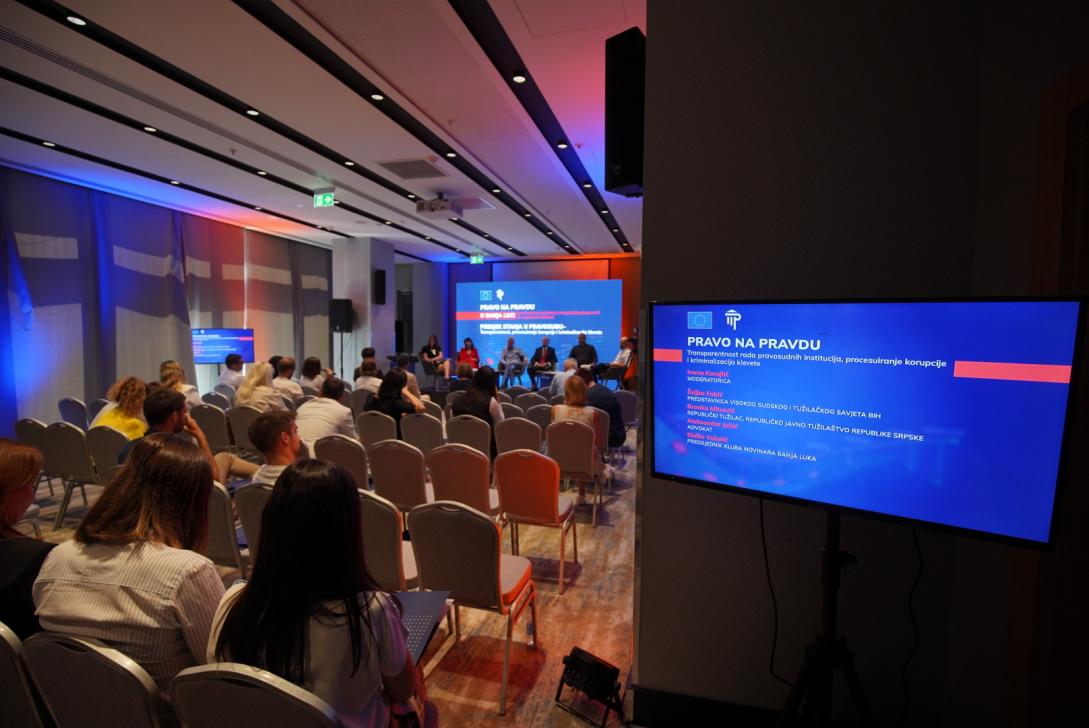
Following „The Right to Justice“ public discussions in eight local communities across Bosnia and Herzegovina, the final event in the series took place in Banja Luka on 29 August 2023. Over 500 citizens, activists, representatives of judicial institutions, and members of the media participated in the series of discussions including the final one, organized by the European Union in Bosnia and Herzegovina. The public debates aimed to establish an open platform for dialogue between the judiciary and the public, addressing topics such as the transparency of institutions, the prosecution of corruption, and other aspects of the rule of law.
During „The Right to Justice“ debate in Banja Luka, the report titled „The Judiciary in BiH between Public Needs and Politics: Nontransparency, Inefficiency and Public Distrust“ by Ivana Korajlić and Denis Džidić was presented. The report provided an overview of various shortcomings in the transparency of judicial institutions in Bosnia and Herzegovina, along with variations in the efficiency of processing corruption cases across different levels and jurisdictions. Additionally, current issues related to amendments to the Criminal Code of the RS regarding the criminalization of defamation were discussed.
„Critical voices, whether they come from citizens, media, activists or civil society organizations, are a key force for positive change. During 'The Right to Justice' public debate, citizens discussed their experiences with the judiciary with representatives of the judiciary. Information and experiences shared by citizens are important and give strength for reforms and the realization of equality of citizens before the law. The participants in 'The Right to Justice' discussions provided many examples of cases of criminal charges that were processed very slowly, examples where there was a lack of proactivity in informing the public about cases of great interest, as well as inefficiency in the processing of corruption cases. The rule of law is central to the 14 key priorities that BiH needs to fulfill before the opening of pre-accession negotiations for joining the European Union,“ said Adebayo Babajide, Deputy Head of the EU Delegation to BiH.
After hosting public discussions in July and August this year in Zenica, Bihac, Livno, East Sarajevo, Mostar, Trebinje, Doboj, and Bijeljina, various local issues of importance to citizens were identified. These included concerns about the inadequate effectiveness of prosecutors' offices following reports by environmental activists, the inadequare system of resolving property-legal lawsuits, apprehension among activists and journalists due to potential abuses stemming from the criminalization of defamation in Republika Srpska, and a perceived weak judicial response to election irregularities. Key messages emerged from these local communities, underscoring the necessity to invest efforts in strengthening the rule of law and the independence of the judiciary. Moreover, the importance of fostering improved cooperation between institutions, enhancing witness protection, and preventing political influence on the judicial system was emphasized.
Regarding the state of the rule of law in Bosnia and Herzegovina, Ivana Korajlić, the Executive Director of Transparency International in BiH, noted that she does not perceive a consensus on the essential laws needed in the country.
„First of all, we are talking about the law on courts, which was removed from the Council of Ministers at the last session, but also the law on the High Judicial and Prosecutorial Council, where again we did not get all the adequate mechanisms that would ensure the accountability of the holders of judicial functions, especially when we talk about the conflict of interest. One of the priorities and what the European Commission insisted on was not only changes to the law on the HJPC, but also the introduction of a new law that would enable not only greater responsibility in the appointment process, but also the responsibility of the High Judicial and Prosecutorial Council itself and its composition”, Korajlić said.
“We all agree in this country that the judiciary in Bosnia and Herzegovina is inefficient, corrupt and does not do its job well. In such a judiciary, politics has put a dangerous tool in its hands, which is the criminalization of defamation. We are afraid that with just such a tool, the freedom of public speech in Republika Srpska, but also in the whole of Bosnia and Herzegovina, will be stifled to the end,” said Sinisa Vukelic, president of the Club of Journalists Banja Luka.
The report presented in Banja Luka offers several recommendations, including the imperative to guarantee transparent operations of the prosecutor's office when handling complaints related to defamation against citizens. It emphasizes the need for judicial oversight in these cases to forestall potential abuses and safeguard fundamental rights. Additionally, the report underscores the necessity for enhanced cooperation between institutions, allocation of sufficient resources, and the implementation of effective mechanisms for the protection of witnesses and whistleblowers in corruption cases.
Among the recommendations is a call for more proactive measures to prevent political influence on the judicial system. This involves primarily fortifying the accountability mechanisms of those holding judicial functions. The report also advocates for the establishment of regular communication channels with activists and non-governmental organizations that submit reports to prosecutors' offices. Furthermore, it encourages a more proactive approach in disseminating information to the public about institutions' responses to cases of significant public importance.