
EU and UN join forces for EUR 7.5 million project to strengthen prevention and response to gender-based violence in Bosnia and Herzegovina
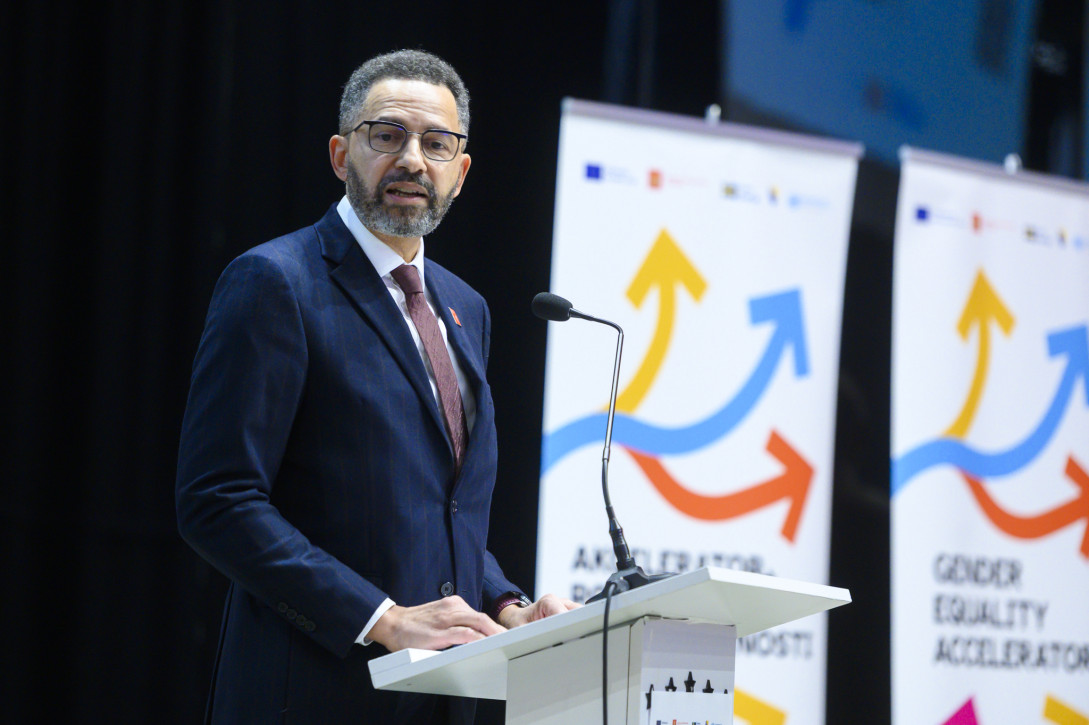
More than 120 practitioners from 55 cities across Bosnia and Herzegovina gathered in Sarajevo from 8-10 December for a three-day event, which also served as the launch of the new EU funded Programme ‘Advancing Prevention and Response to Gender-Based Violence in Bosnia and Herzegovina’ worth EUR 7.5 million. The programme is one of the key pillars of the Gender Equality Accelerator (GEA) - a joint programme supported by European Union, Sweden and Denmark, and implemented by UN Women, UNDP, UNFPA and UNICEF as part of the United Nations’ cooperation with institutions of Bosnia and Herzegovina.
Over three days, representatives of line ministries, social welfare and justice institutions, police, health services, safe houses, survivor-led and women’s rights organisations, as well as organisations working with Roma communities, women with disabilities, LGBTQI+ people, youth and faith communities, worked together to identify gaps and design a concrete pathway for a survivor-centred system of protection and support in every community.
The roadmap aims to ensure that over the next three and a half years, the current fragmented and isolated responses to gender-based violence in Bosnia and Herzegovina evolve into a coordinated system of protection that is centred on survivors and supports their economic empowerment. It focuses on establishing effective coordination and a shared information system among police, justice, social welfare, health services and safe houses, as well as other local support services such as public kitchens, which can provide emergency material assistance and play a role in referring women to relevant institutions. It also prioritises the introduction of trauma-informed practice and the creation of sustainable economic pathways for women who have survived violence. Furthermore, the roadmap emphasises long-term partnerships with communities and groups facing multiple forms of discrimination to drive shifts in social norms and reduce tolerance for violence.
“Bosnia and Herzegovina has taken on clear obligations through the Istanbul Convention and the Law on Gender Equality, yet many women still experience violence and do not receive equal protection. The EU programme and the entire Gender Equality Accelerator, is crucial to building a coordinated, multisectoral response and turning those commitments into real safety and support for all women, especially those most marginalised”, said Samra Filipović-Hadžiabdić, Director of the Agency for Gender Equality of Bosnia and Herzegovina, Ministry for Human Rights and Refugees of BiH.
The programme will help make services safer, more accessible and more supportive for women who experience violence, from social protection and health care to justice and policies. It will also back key legal reforms, improve economic environment for survivors and work with civil society and local community partners to shift social norms that enable violence.
“Ending violence against women and girls is a core European value and a requirement on the country’s EU path. With an investment of EUR 7.5 million, the European Union is supporting stronger institutional responses to gender-based violence in Bosnia and Herzegovina, including safer services, support to survivors and economic opportunities for women. This project also supports key reforms that Bosnia nad Hercegovina needs to implement, from human rights and anti-discrimination to social protection and the rule of law, because violence against women and girls has no place in our society”, stated Adebayo Babajide, Deputy Head of the Delegation of the European Union to Bosnia and Herzegovina.
Launched during the global 16 Days of Activism against Gender-Based Violence campaign, the consultative event comes at a time of rising concern over femicides and other forms of violence against women and girls in Bosnia and Herzegovina. The Gender Equality Accelerator was developed in response to this alarming trend, and the EU “Gender and Social Assistance Programme” is a central part of the joint effort to ensure that institutions work together, earlier and more effectively, to prevent violence and protect survivors.
“Violence against women in Bosnia and Herzegovina remains an urgent challenge, with gaps in protection and support leaving many survivors without timely help, as reflected in the 2025 EU Progress Report. The launch of the EU Gender and Social Assistance Programme marks an important step in addressing these gaps, by strengthening services for the most vulnerable women – especially Roma women, women with disabilities and women in rural areas.” said Jo-Anne Bishop, UN Women Representative in Bosnia and Herzegovina.
The priorities identified during this consultative launch will now guide implementation of the EU “Gender and Social Assistance Programme” and broader “Gender Equality Accelerator”, translating dialogue into concrete action.