
EU, Southern Neighborhood policy makers and experts discuss strategies to combat looming global food and climate crisis
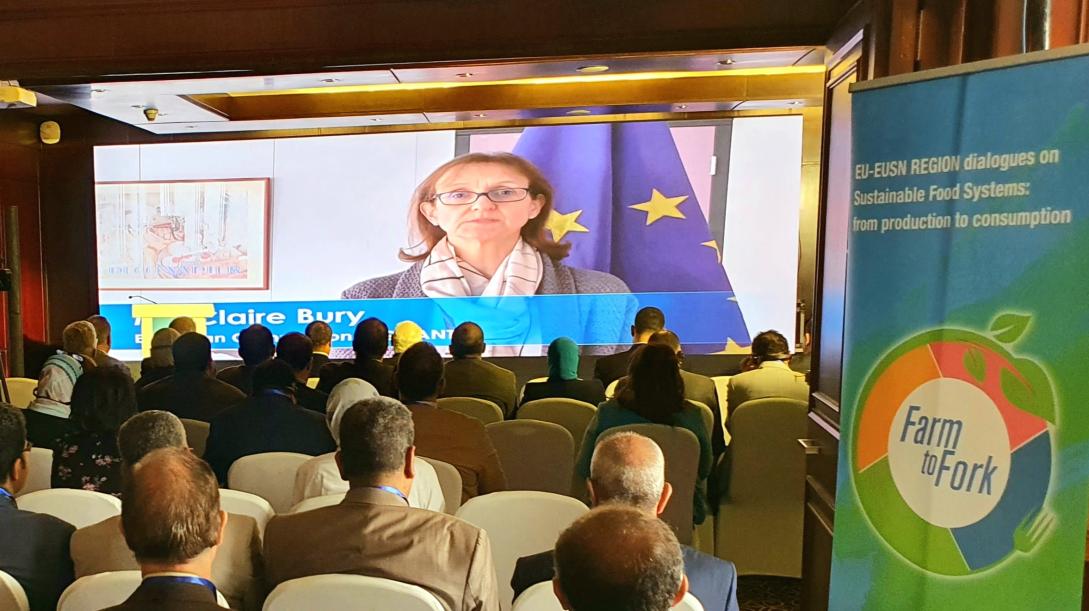
Cairo, 16 May 2023: Stakeholders from Egypt, Algeria, Tunisia, Libya, Lebanon and Jordan have expressed similar concerns regarding environmental degradation caused by agriculture and farming as well issues of food security, healthy nutrition and food waste reduction. All agreed that holistic and long term actions must be put in place.
The talks between the European Union (EU) and six countries in Middle East-North Africa region were held at the Hilton Zamalek and online, as part of EU-funded workshop series supporting the ‘Farm to Fork’ (F2F) Strategy put in place by the EU in the context of the wider ‘Green Deal’.
The COVID-19 pandemic, the Ukraine crisis and ongoing extreme weather conditions caused by climate change, have disrupted global food supply chains and communities around the world, causing a risk of food insecurity and food related health threats such as hunger or obesity. In addition, current food production, transport and processing methods are one of the largest contributors to global warming with 21-37% of greenhouse gas emissions attributed to food chains.
Opening the workshop, Claire Bury, Deputy Director General for Directorate-General for Food Sustainability, EU Commission said “In Europe, our citizens continue to express their concerns about the climate and biodiversity loss. Their recommendations support the sustainability policies we are developing, and the cooperative work we want to develop set out the way forward”.
Koen Van Dyck, EC DG SANTE Head of Unit A5, emphasized that “COVID-19 was one pandemic but there will be others, and it’s important that food systems can better react and be better prepared when another pandemic comes.” Rightfully, “There is huge potential for transformation in the region if collaboration and alignment on a road map is set” urged Yahia Al-Wathik-Bellah, First Undersecretary of the Ministry of Trade and Industry of Egypt.
This workshop allowed dialogues between the EU and five neighboring countries of Egypt (Algeria, Tunisia, Libya, Lebanon, Jordan) in order to exchange views regarding soil health, sustainable use of fertilisers and innovation; sustainable use of pesticides; as well as food loss, waste and sustainable consumption.
“The most severe impact of global warming will be felt in the Mediterranean and Atlantic regions. We cannot have a green Europe at the expense of Africa” said Adel Al-Beltagy, Ex-Minister of Agriculture and Land Reclamation of Egypt.
Asserting that Jordan has the second highest share of refugees per capita in the world, Sa’eb Khresat, former President of the Jordan University for Science and Technology, insisted that such fact “puts unprecedented pressure on local natural resources - including water.” Indeed, “there needs to be better use of water resources and we should work on solving water imbalances in desert zones”, emphasized Yacine Hammouni, Engineer of Agriculture at the Ministry of Agriculture and Rural Development of Algeria.
As a recommendation, “this is a difficult time but it brings opportunities: we need to cooperate more with the EU and neighboring countries in the region to maximise food production with less environmental impact”, pointed Abubaker Hamad Almansori, Chairman of Food Security Strategy Programme, former Minister of Agriculture of Libya.
Mentioning Tunisia among other concerned countries, “developing a sustainable agrifood national system is a huge challenge, and food loss is an entry point for looking at the system as a whole" said Jennifer Smolak, Value Chain Specialist, FAO Regional Office for the Near East and North Africa. A complementary message was echoed by Ramy Boujawdeh, COO of Berytech from Lebanon : "People should be able to keep living in rural areas so we have to make sure the economy works for them, by producing better and more sustainably."
Bearing in mind that as part of its Green Deal, the EU has proposed ambitious actions and commitments to transform its food systems (the Farm to Fork Strategy) into global standards for competitive sustainability, the protection of human and planetary health as well as the livelihoods of all actors in the food value chain, Cristina Laso Sanz -Deputy Head of Unit A5 (Bilateral International Relations) at EC DG SANTE- closed the Workshop by reassuring that “we agree there is not a one-size-fits all solution: diversity of organisations and value chains, diversity of solutions, technology and nature-based solutions are key to succeeding.”
------------------------------
Background information:
The adjustment of food systems, which were also documented and called upon in the UN Food Systems Summit in September 2021, needs to take into account the various contextual differences across the planet regarding cross cutting issues such as land degradation or food loss that ultimately affect how food is produced, processed, transported and consumed.
The question of sustainable food systems goes beyond the means of production and is also subjected to several nutrition challenges such as undernutrition and hunger. These challenges persist while new and multiple forms of malnutrition rise. In particular, food-borne non-communicable diseases such as cancer, obesity, and cardiovascular conditions put pressure on people and health systems.
Although global awareness grows, commitments are made and some solutions are designed and implemented, there is still a need for rapid and firmer action to foster a worldwide cooperation and coordination.
This series of regional and country-focused workshops is funded by the European Commission’s Service for Foreign Policy Instruments (FPI) under the project supporting the Farm to Fork Strategy (F2F), which is the EU plan to contribute to resolving food challenges, and, to this end, proposes pathways for change towards sustainability that provides environmental, health, social and economic benefits.
More details of the European Commission’s Farm to Fork strategy are available here and on Social Media channels with the tags:
#EUFarm2Fork @EU_FPI
#EUForeignPolicy
###For more information, please contact:
“F2F – Farm to Fork” Project Secretariat (General organisation):
Philippe van Maldeghem - farm2forkdialogue@candm.sk