
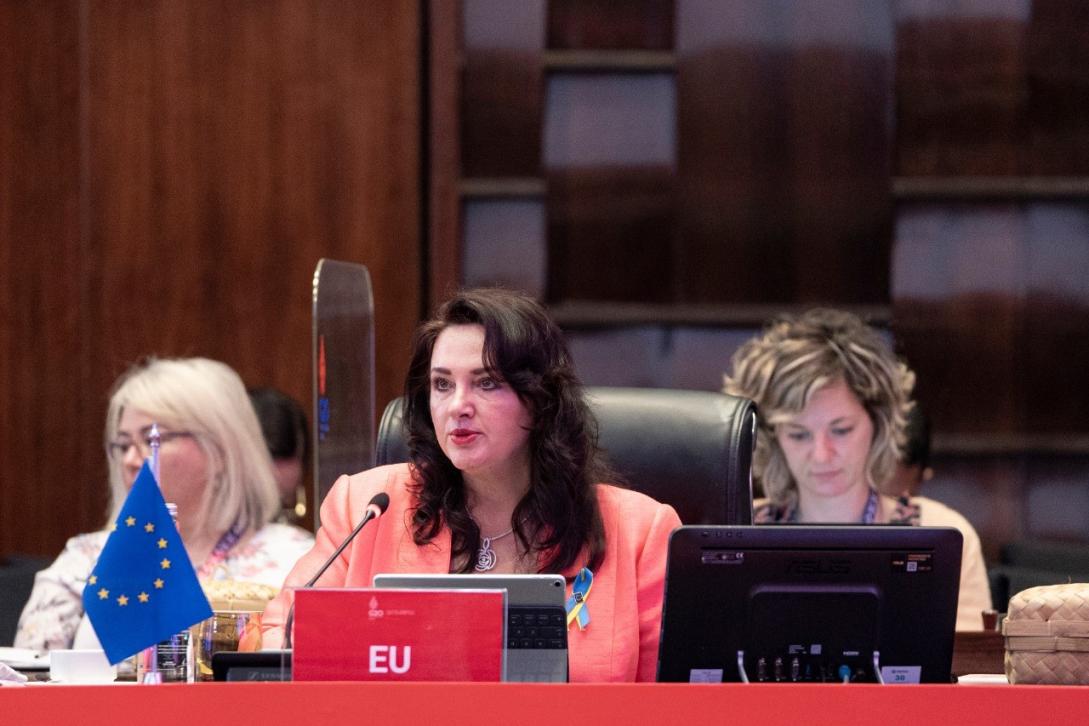
Speech by European Commissioner Helena Dalli at the G20 MCWE session on 'Women's Entrepreneurship'
Check Against Delivery
Speech by European Commissioner for Equality Helena Dalli at the session on ‘Women’s Entrepreneurship: Accelerating Equality, Accelerating Recovery’ of the G20 Ministerial Conference on Women’s Empowerment (MCWE) 2022
Bali, 25 August 2022
We are gathered here today to discuss the central role women play, and must continue to play, in the global economic recovery. But we cannot address the drivers of economic growth without acknowledging the devastating impact of Russia’s unprovoked invasion of Ukraine, and the global food and energy crises it has triggered. Beyond the lives of Ukrainian people, with whom the EU stands in full solidarity, the war launched by Russia jeopardises the livelihoods of millions of people around the world who fear they will not be able to afford to heat their homes or feed their children.
Coming back to today’s theme, we know that when women can be part of and are able to thrive in the labour market, economic growth and prosperity is greater. Yet women face several barriers getting there.
When it comes to entrepreneurship, women are less likely than men to borrow and save to start, operate and expand a business. And they face greater challenges in accessing financial accounts and services than men. For instance, in Sub-Saharan Africa and the Middle East & North Africa, less than 40% of women have a financial account. This is on top of an unfair care burden and a continued “male breadwinner” bias.
We also need to care about women’s entrepreneurship because it can directly empower women.
In lower income countries, only 7% of women are employed as wage workers. Targeted support is crucial.
This is why the EU supports its international partners in this endeavour.
- For instance, we have an 8-million euro programme with the UN entitled WeEmpower Asia. Ths is enabling a business environment that empowers women by providing skills training for female entrepreneurs to engage with businesses, policymakers and decision-makers.
- Last December, more than 80 Indonesian SMEs joined training sessions, including Elsye Suryawan. Elsye runs a women’s business group for working mothers and heads a non-profit organisation, here in Bali, that caters to the needs of persons with disabilities.
We also support women’s entrepreneurship within the European Union.
- In our support for SMEs we empower women and girls to become founders. This is important in a world where men still outnumber women 3 to 1 when it comes to business ownership.
- We fund projects to promote role models, improve access to networks and mentoring for women as well as communities of practice where experiences and problems-solving are shared.
- Since 2016, we have sponsored WEgate, a European online platform that helps to create real opportunities for women to do business, expand their network, and learn from mentors and peers how to achieve their full potential. More than 3000 women entrepreneurs have benefitted from this.
- This year, the EU has adopted legislation that will ensure women and men are equally represented on company boards EU-wide.
We know the power of women leadership.
Indeed, there is evidence that suggests that companies with more female leaders can outperform those dominated by men. This is why I want to see the World Economic Forum and the International Monetary Fund include women’s leadership as a core criterion of Country Competitiveness.
We are always looking at where targeted support is needed by collecting data on the barriers, drivers and enablers for women entrepreneurs of all ages. This is essential.
It is why all companies registered in G20 countries with over 250 employees should disclose data on their progress towards the G20 Empower Key Performance Indicators. At the same time, equality still needs to be truly understood. And as Indonesian business owner Elsye Suryawan says, it has to be understood from an early age.
So as we talk about recovery today and the importance of supporting female entrepreneurship, we must also talk about the need to double down in our efforts to educate our children about equality.
This starts at home with equal responsibility for childcare and domestic work.
In the EU, there are still stark differences between our Member States, and the pandemic only reinforced them. For instance, teleworking was good for parents to combine work responsibilities and care for children or relatives. However nearly 30% of women found it hard to concentrate compared to only 16% of men in the same situation. Only a few men took on more of the care burden compared to so many women. This also directly translated into women facing more mental health problems during the pandemic than men.
This is not unique to the EU. It is a truly global problem which requires a global consensus. Our economic recovery requires a well-functioning care sector. As when formal care services are closed, women are still expected to assume a greater share of unpaid care of children, older relatives and persons with disabilities who need support, than men.
This is why, as of 2nd August, the EU has introduced common legal safeguards for parents and carers to have sufficient time and space to care for their families and advance their careers. For instance, each parent is now entitled to at least 4 months of parental leave, two of which are non-transferable.
In September, the European Commission will also present a European care strategy to address both carers and care receivers, from childcare to long-term care. The Strategy will set a framework to guide the development of sustainable long-term care ensuring better and more affordable access to quality services for all. It will also contribute towards gender equality, women’s empowerment and participation in the labour market, by encouraging increased participation of children in early childhood education and care, as well as the quality, affordability and accessibility of these services.
Besides, educating our children about equality also means addressing harmful stereotypes once and for all.
Even in films, research shows that women in leadership positions are more often sexualised rather than shown as positive role models. Gender equality should be clearly present in our education systems too, from kindergarten to university. This is still not the case across the EU or beyond and must change.
We will soon be running a major communication campaign in several EU countries to address harmful stereotypes. Furthermore, we need a renewed global push to end violence against women. This global effort is not only necessary for its intrinsic value but also because, in this context, violence impinges upon women’s productivity at work. Once more, this is something the pandemic made worse, just like the rest of the obstacles women face. Therefore we must now redouble our efforts to end it for our recovery.
When women work, our economies grow. More women in business makes economic sense, and we must help them get there. At the same time, we must continue the struggle for equality from an early age through the education system and by ridding society of harmful stereotypes. And we must end violence against women. Coupled with targeted support for women’s entrepreneurship, these three goals will also help women break down the barriers not just in business but to the whole labour market.
I thank you.