Stolen childhood: bringing Ukraine's children home

The treatment of Ukraine's children over the last four years is the clearest example of Russia's total disregard for life.
EU High Representative for Foreign Affairs and Security Policy Kaja Kallas, speech to European Parliament
- Follow the link to the speech to the European Parliament by HR/VP Kaja Kallas
A child should grow up surrounded by family, friends and the familiar sounds of home. But for over 20 600 Ukrainian children, Russia's war has meant separation from their families, forcible transfers to Russia and Ukraine’s temporarily occupied territories, and attempts to erase their Ukrainian identity. The EU strongly condemns Russia’s violations of human rights and international law and has been cooperating with Ukraine and international partners to secure the safe and unconditional return of all Ukrainian children to their families.
European Union 2026
After being deported and forcibly transferred from their homes, these Ukrainian children have been placed in Russian families, subjected to ideological indoctrination and exposed to militarised education. Their stories are not just about the loss of childhood, but also about Russia’s deliberate attempt to deprive them of their national identity, culture and future of their own choice.
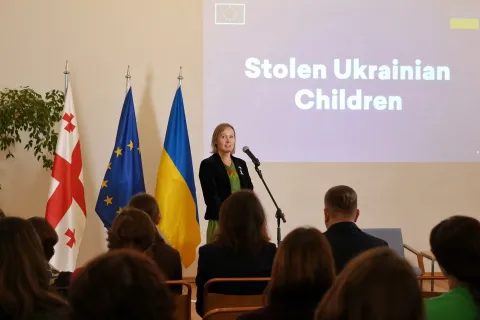
The EU Delegation to Georgia and the Embassy of Ukraine brought this issue into focus in Tbilisi with a screening of the documentary Stolen Ukrainian Children on 20 November 2026 for World Children's Day. It was followed by a discussion with its authors, journalists Manon Bachelot and Poline Tchoubar.
Attempt to erase identity
The documentary, produced by CAPA Presse and the Franco-German broadcaster ARTE, investigates how Ukrainian children have been deported from their families and transferred to Russia, where many have been subject to ideological re-education, Russification and militarisation.
The investigation reveals how children from temporarily occupied Ukrainian territories have been transferred to facilities across Russia, and in some cases placed with Russian families or offered for adoption.
The scale and systematic nature of these practices have also been documented internationally. An OSCE report published in 2026 detailed a state-orchestrated campaign in temporarily occupied territories aimed at erasing Ukrainian children's identity from early childhood onwards.
As High Representative Kaja Kallas stressed in the European Parliament, the evidence points to crimes against humanity. Watch the video below to hear her comments.
Thousands of children
According to Ukrainian authorities, more than 20 600 Ukrainian children have been documented as having been unlawfully deported and forcibly transferred by Russia since the beginning of its full-scale invasion of Ukraine. The actual number is believed to be considerably higher. Watch the video below to hear testimonies from some of those deported and forcibly transferred children which were gathered by the NGO Brings Kids Back.
While international efforts have helped secure the return of some children, thousands remain separated from their families. To this date, 2833 children have been returned home from deportation, forcible transfers, and temporary occupation. Every return is a step forward, but the work is far from over.
Bringing every child home
Bringing Ukraine's children home is not only about returning them to where they belong. It is about restoring the childhood and future that Russia's war has sought to take away. The EU is working on several fronts to secure the safe and unconditional return of all Ukrainian children.
- Supports UN General Assembly’s resolutions and, together with Ukraine and Canada co-hosted a major international conference in Brussels on 11 May 2026, bringing together global partners to strengthen efforts to trace and return the children.
- Supports the International Coalition for the Return of Ukrainian Children and backs the work of the International Criminal Court.
- Imposed sanctions to target those responsible for the forced transfer and indoctrination of Ukrainian children, including Russian children’s camps and Songdowon International Children’s Camp in North Korea, to where Ukrainian children were transferred. Follow the link for more information about sanctions against child deportations in Ukraine
- Provides financial support to protect Ukrainian children and help restore their access to education and essential services. Recent funding includes
- Close to €30 million in humanitarian aid for children and children's facilities
- €10 million for education and learning support for children and teachers
- €5 million to restore access to local education systems in war-affected communities
- €4 million to support unlawfully deported Ukrainian children, including €1.75 million for accountability efforts related to these crimes.
On World Children's Day, the screening in Tbilisi served as a reminder that children's rights do not stop at borders or disappear in times of war. Every child has the right to grow up with their family.
Who are “deported Ukrainian children”?
Since the beginning of the Russian war of aggression against Ukraine, Russia has deported and forcibly transferred over 20 6000 children of Ukrainian origin to Russia. They are denied reunification with their parents in their home country of Ukraine and subject to Russification. The European Union is committed to ensuring that every Ukrainian child that was unlawfully deported by Russia returns home. Follow the link to learn more about the campaign to Bring Ukrainian children back home.