Middle East and North Africa (MENA)
The European Union has been present in the Middle East and North Africa since 1979, through a growing number of Delegations in the region. The latest one to open was the EU Delegation to the State of Qatar in September 2021.
The EU’s policy towards the North African and Middle Eastern countries seeks to encourage political and economic reform in each individual country in due respect for its specific features (European Neighbourhood Policy) and regional cooperation among the countries of the region themselves and with the EU (Union For the Mediterranean). The EU reaffirms its commitment to a just and comprehensive resolution of the Israeli-Palestinian conflict, based on the two state solution, with the State of Israel and an independent, democratic, contiguous, sovereign, and viable State of Palestine, living side by side in peace and security and mutual recognition, and with Jerusalem serving as the future capital of both states. For this purpose, the EU is active in the Middle East Peace Process.
In January 2021, the EU’s first Arabic speaking Regional Media Officer for the Middle East and North Africa took office. His role is to communicate on EU priorities, policies, positions and projects of interest to the MENA region, complementing the work of the EU Delegations present in the region.

-
Image
 Copyright
European Union, 2025
Pact for the Mediterranean
On 16 October 2025, the European Commission and the High Representative unveiled an ambitious strategy to enhance relations with Southern Mediterranean partners: The Pact for the Mediterranean. The Pact is designed to deepen cooperation and economic connections, addressing shared challenges and aspirations rooted in our historical and cultural ties. By focusing on mutual interests, this Pact aims to create a Common Mediterranean Space that is more connected, prosperous, resilient, and secure, benefiting all nations bordering the Mediterranean Sea and beyond.
The Pact for the Mediterranean was launched on 28 November 2025 in Barcelona, where Ministers from EU Member States and Southern Mediterranean countries gathered to mark this historic moment for stronger cooperation. The launch event co-chaired by the High Representative/Vice President Kaja Kallas and Commissioner for the Mediterranean Dubravka Šuica coincided with the 30-year anniversary of the Barcelona Process, a longstanding initiative promoting cooperation and stability between the EU and Mediterranean countries.
The Pact focuses on practical steps to foster collaboration and mutual benefits across the Mediterranean. Built on shared responsibility and co-creation, it aims to deliver tangible improvements for people and economies in the region, including clean energy projects and unlocking private investment. By launching regional initiatives, the Pact creates opportunities for everyone, especially youth, women, and small businesses. It also enhances cooperation in security and migration management, addressing vital issues like maritime security and infrastructure resilience.
Three Pillars of the Pact:
1. People: driving force for change, connections and innovation. This pillar aims to empower individuals through education, training, and jobs, with a spotlight on youth. Initiatives include establishing a Mediterranean University to link students across the region and expanding technical and vocational training. Under a Heritage mechanism, the EU will also support cultural heritage, artists, and sustainable tourism.
2. Stronger, more sustainable and integrated economies: This pillar focuses on modernizing trade, promoting clean energy, and enhancing connectivity. Flagship projects like the Trans-Mediterranean Renewable Energy and Clean Tech initiative (T-MED) and StartUp4Med will drive innovation. Efforts will be made to integrate supply chains and improve digital infrastructure, fostering a sustainable blue economy in the Mediterranean.
3. Security and Migration Management: The Pact tackles common security challenges and improves regional preparedness. Key initiatives include disaster resilience and a comprehensive approach to migration, promoting integrated border management and countering smuggling. A regional forum on peace and security will bring the EU and Southern Mediterranean countries together.
The Pact is open to collaboration beyond the Southern Mediterranean, engaging with partners from the Gulf, Sub-Saharan Africa, the Western Balkans, and Türkiye. Strengthening ties between the EU, the Middle East, North Africa, and the Gulf is a central goal.
On 17 April 2026, at the meeting of the joint EU-Mediterranean group at senior official’s level in Brussels, the first edition of the Pact for the Mediterranean Action Plan was presented to advance the implementation of the Pact. The Action Plan launched a set of 21 concrete actions ready for implementation this year under the Pact’s three pillars.
*This designation shall not be construed as recognition of a State of Palestine and is without prejudice to the individual positions of the Member States on this issue.
The EU and the Union for the Mediterranean (UfM)

European Union, 2025
The Union for the Mediterranean (UfM) is an inter-governmental Regional Organisation that promotes cooperation and dialogue in the Euro-Mediterranean region through concrete projects and initiatives, focusing on strategic objectives of regional stability, human development, and regional economic integration. The EU holds the role of Co-Chair, currently alongside Jordan, and provides considerable funding (more than 50% of the UfM Secretariat budget).
Union for the Mediterranean Structure
Launched in 2008, building on the Barcelona Process (also called the Euro-Mediterranean partnership, created in 1995), the UfM is the regional framework for political, economic and social dialogue and cooperation in the Mediterranean. Along with the 27 EU Member States, 16 Mediterranean countries are members of the UfM: Albania, Algeria, Bosnia and Herzegovina, Egypt, Israel, Jordan, Lebanon, Mauritania, Monaco, Montenegro, Morocco, North Macedonia (joined in 2022), Palestine, Syria, Tunisia, and Türkiye. Libya has observer status. Since 2012, the EU and Jordan jointly hold the Presidency of the UfM. UfM Senior Officials Meetings (SOMs), co-chaired by the European External Action Service (EEAS) and Jordan, oversee the activities of the UfM.
The UfM Secretariat, based in Barcelona, ensures the operational follow-up of the regional priorities identified at the UfM’s sectoral Ministerial meetings. Its operational budget is financed by the EU and by contributions from the 43 UfM member states. Currently, 6 Deputy Secretary-Generals (three from the EU and 3 from the Mediterranean partners) steer the sectoral work of the UfM, namely via thematic regional dialogue platforms. UfM Regional Policy Platforms exchange on sectorial ministerial mandates, coordinate their implementation and promote concrete projects for cooperation. They involve a large network of more than 30 000 stakeholders (international organisations, civil society representatives, international financial institutions, development agencies, private sector entities and universities, etc). The UfM Secretariat promotes region-wide cooperation projects and initiatives that address the root causes of regional stability and socio-economic challenges. So far, the UfM has attributed its label to more than 60 projects.
UfM Priorities
Foreign Ministers of the UfM countries meet since 2015 in an annual Regional Forum, under the co-chairmanship of the EU High Representative / Vice President and the Deputy Prime Minister and Minister of Foreign Affairs of the Hashemite Kingdom of Jordan. In 2025, at the 10th UfM Regional Forum, Ministers welcomed a new Vision Statement for the UfM, with a new set of priorities (centred around the concept of connectivity) and adopted a new structure for the Secretariat, to improve its agility, visibility and efficiency.
Under the EU-Jordan co-presidency, more than 35 UfM Ministerial Meetings have been organised up to now on important domains for the region such as Energy, Transport, Women Empowerment, Industrial Cooperation, Environment, Climate Action, Digital Economy, Trade, Employment and Labour, Water, or Sustainable Urban Development.
The UfM coordinates the Day of the Mediterranean, celebrated every 28 November since 2021, with the aim to foster a common Mediterranean identity, embrace diversity and celebrate cooperation in the Euro-Mediterranean region, and together with the Anna Lindh Foundation, organises a Mediterranean capitals of culture and dialogue, to promote the diversity and shared identity of the Mediterranean Basin, and to contribute to a better mutual understanding of its peoples.
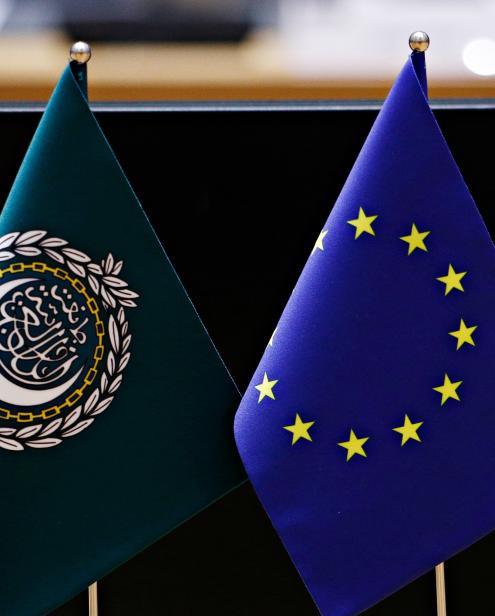
The EU and the League of Arab States (LAS)
Dialogue and cooperation between the European Union and the League of Arab States (LAS) builds on the mutual interest to address together common political, economic, and security challenges with a view of sharing a better future for all. Regular Euro-Arab high-level dialogues were established in 2014 and have since provided a means to discuss joint responses to common global and regional challenges to build peace in the region.
The League of Arab States (LAS), also often referred to as Arab League, is an intergovernmental regional organisation founded on 22 March 1945 in Cairo (Egypt), following the adoption of the Alexandria Protocol in 1944. Its goal focuses on strengthening ties among its Member States, coordinating their policies, and promoting common interests, particularly in areas like politics, economics, social policies, health, culture, and security, all while safeguarding their independence and sovereignty. Initially founded by seven member states, the Arab League currently gathers 22 Arab countries incl. Algeria, Bahrain, Comoros, Djibouti, Egypt, Iraq, Jordan, Kuwait, Lebanon, Libya, Mauritania, Morocco, Oman, Palestine, Qatar, Saudi Arabia, Somalia, Sudan, Syria*, Tunisia, the United Arab Emirates, and Yemen. As the only pan-Arab organisation, the EU’s cooperation with LAS provides a unique opportunity to develop closer relations between the Arab World and the European Union.
EU-LAS Cooperation Framework
EU–League of Arab States (LAS) relations began in 2008 with the first ministerial meeting in Malta, followed by a second meeting in Cairo in 2012 after the Arab Spring. These meetings helped move the partnership from dialogue to regular cooperation, including routine meetings between senior officials.
In 2014, Ministers agreed in Athens to launch an EU-LAS Strategic Dialogue, bringing together EU and Arab ambassadors to discuss political and security issues. This cooperation was further strengthened in 2015 with a Memorandum of Understanding between the EEAS and the LAS, which enabled practical collaboration, diplomat exchanges, and joint working groups on key topics.
A fourth ministerial meeting in Cairo in 2016 led to the decision to hold Euro-Arab Summits at leaders’ level. This paved the way for the first EU-LAS Summit in Sharm El-Sheikh in 2019, following a preparatory ministerial meeting in Brussels. Leaders committed to closer cooperation to support stability and prosperity in both regions.
After a period of limited engagement from 2023 to 2024, the EU fully renewed its cooperation with the LAS in late 2024. 2025 has seen several formal and informal high-level exchanges with the League of Arab States, especially in the context of the EU’s support to a Two-State-Solution and the war in Gaza. Additionally, the 10th EU-LAS Strategic Dialogue took place in Brussels on 4 November 2025.
EU-LAS cooperation in Practice
Cooperation between the EU and the League of Arab States has evolved over time.
At the political level, and beyond the regular institutional dialogues outlined in the section on the cooperation framework, the EU and League of Arab States (together with Egypt, Jordan and Saudi Arabia) launched the “Peace Day Effort” for Middle East Peace on the margins of a UN ministerial meeting in New York, in September 2023. Momentum has also grown in the framework of the” Global Alliance for the Implementation of the Two State Solution”. The Alliance seeks the peaceful settlement of the Israeli-Palestinian conflict based on the Two-State Solution, allowing both Israelis and Palestinians to coexist peacefully and for a better future for everyone in the region. Follow the links to read more about the Middle East Peace Process and the role of the EU Special Representative for the Middle East Peace Process.
At the technical level, the El-Hiwar Project financed by the European Commission has been at the heart of Euro-Arab Dialogue since 2013 and is currently in its third phase (2023-2026). The Commission is also financing another project called Halaqat (launched in 2021 and currently in its second phase, 2024-2027), which provides a space for cultural actors from Arab and European countries.
Thematic cooperation between the EU and the League of Arab States takes place in different fields. A concrete example is the EU’s support towards combating the illicit trade in and proliferation of small arms and light weapons in the Member States of the League of Arab States, a project financed under the EU’s Common Foreign and Security Policy budget since 2018 (currently in its third phase, 2024-2027). Another concrete example is the so-called “EU-ACT: EU Action Against Organised Crime and Terrorism” global programme (providing EUR 19m over the period 2023-2028), which supports EU Action against Organised Crime and Terrorism. In the Middle East it aims at working with Arab Interiors Ministers Council (AIMC), in partnership with League of Arab States health department on the roadmap towards the Arab Drug Observatory. It is also a follow-up to the process on international judicial cooperation, in continuity with the work initiated by CT JUST project (2022-2026).
-
Image
© Shutterstock
Middle East Peace Process
The Resolution of the Arab-Israeli conflict is a fundamental interest of the EU. The EU’s objective is a two-state solution with an independent, democratic, viable and contiguous Palestinian state living side-by-side in peace and security with Israel and its other neighbours.
The EU has consistently expressed its concerns about developments on the ground, which threaten to make a two-state solution impossible. In our view, the only way to resolve the conflict is through an agreement that ends the occupation which began in 1967, that ends all claims and that fulfils the aspirations of both parties. A one state reality would not be compatible with these aspirations. A lasting solution must be achieved on the basis of the relevant UN Security Council Resolutions, the Madrid principles including land for peace, the Roadmap, agreements previously reached by the parties and of the Arab Peace Initiative. If an agreement to finally end the conflict were to be reached, the door would open to a deepened and enhanced cooperation among all the countries of the region.
The EU is willing to work with its partners to re-launch peace negotiations, based on the following parameters:
- An agreement on the borders of the two states, based on the 4 June 1967 lines with equivalent land swaps as may be agreed between the parties. The EU will recognize changes to the pre-1967 borders, including with regard to Jerusalem, only when agreed by the parties.
- Security arrangements that, for Palestinians, respect their sovereignty and show that the occupation is over; and, for Israelis, protect their security, prevent the resurgence of terrorism and deal effectively with security threats, including with new and vital threats in the region.
- A just, fair, agreed and realistic solution to the refugee question.
- Fulfilment of the aspirations of both parties for Jerusalem. A way must be found through negotiations to resolve the status of Jerusalem as the future capital of both states.
To that end, the EU undertakes a range of activities – both political and practical – and is the largest donor to Palestinian state-building efforts aiming at a Palestinian state based on the rule of law and respect of human rights. It has also consistently called for intra-Palestinian reconciliation and holding of democratic elections.
The EU – with the UN, the US and the Russian Federation – is a member of the 'Quartet' which in 2002 launched a ‘road map for peace’ aimed at resolving the conflict. The EU has welcomed the Arab Peace Initiative as a significant contribution from the Arab countries.
-
Image

© Shutterstock
The EU and the Gulf Cooperation Council (GCC)
The Cooperation Council for the Arab States of the Gulf (GCC) is a regional organisation comprising of six members: The Kingdom of Bahrain, the State of Kuwait, the Sultanate of Oman, the State of Qatar, the Kingdom of Saudi Arabia and the United Arab Emirates. Set up in 1981, its objectives are to enhance coordination, integration and inter-connection among its members.
EU-GCC relations are based on a Cooperation Agreement signed in 1989, which establishes regular dialogue on cooperation between the EU and GCC on economic relations, climate change, energy, environment, and research. Since then, dialogue and cooperation have been intensifying over the years, based on mutual interest to foster relations in all political domains.
On 18 May 2022, the Commission and the High Representative adopted a Joint Communication on a strategic partnership with the Gulf, proposing a comprehensive and stronger partnership between the EU and the GCC and its Member States. It was endorsed by Council Conclusions on 20 June 2022.
In June 2022, the High Representative/Vice President of the European Commission has appointed for the first time ever an EU Special Representative for the Gulf to further develop a stronger, comprehensive and more strategic EU partnership with the countries in the Gulf region. Since 1 June 2023, Luigi di Maio has been appointed to this post with his send mandate ending on 28 February 2027.
EU-GCC Cooperation Framework
The cooperation agreement of 1989 established an EU-GCC Joint Council at Foreign Ministers level that meets regularly and is prepared by a Joint Cooperation Committee discussing and advancing cooperation on sectoral areas of mutual interest.
Building on a strong mutual interest in deepening the trade and investment relations, a trade and investment dialogue has been established in 2017, with the last meeting taking place in Riyadh in March 2023. This sectoral dialogue is supported by an EU-funded project (EU-GCC Dialogue on Economic Diversification) launched in 2019, and second phase in 2025, that supports GCC countries in their economic diversification strategies based on the exchange of EU experience and expertise. The project has been successful in identifying new business opportunities and areas of economic cooperation between the two regions as well as between the EU and individual GCC countries.
Following a temporary halt and the Covid-19 pandemic, EU-GCC meetings were reactivated in 2021 with a series of high-level meetings covering all aspects of EU-GCC cooperation. Since 2022, the EU and the GCC has been convening annual Ministerial meetings at Foreign Minsters level deepening mutual trust, achieving common interests, and maintaining regional and international security – something particularly pertinent considering wars and escalations in Europe and in the Middle East.
EU-GCC Co-Chair Statement 2022
EU-GCC Co-Chair Statement 2023
EU-GCC Joint Council Statement 2025
The year 2024 saw the historic 1st EU-GCC Summit convening in Brussels resulting in a comprehensive Joint Statement where leaders elevated EU-GCC relations to a strategic partnership. The leaders agreed on intensified political dialogue and on collaboration across wide range of issues, including to aim for a regional Free Trade Agreement as well as energy, including green transition, climate action, connectivity, including digital and AI, development financing, education, scientific research and people-to-people contacts.
The EU is present in the region with three EU Delegations accredited to the six GCC Countries, notably the EU Delegation to Saudi Arabia, also accredited to the GCC and also covering Bahrain and Oman, the EU Delegation to the United Arab Emirates and the EU Delegation to Kuwait. In September 2022 the EU opened the EU Delegation to Qatar.
Instruments for cooperation
To advance dialogue and cooperation with the GCC countries on strategic areas of mutual interest, the EU funds a series of projects in the region under the Service for Foreign Policy Instruments.
EU Delegations in the MENA region
EU Delegation to Morocco
The EU’s relations with Morocco are based on the 1996 Association Agreement. Both sides cooperate on trade, climate action, justice and security, mobility and migration, and good governance. The EU is also Morocco’s main trading partner.
EU Delegation to Morocco website
EU Delegation to Algeria
Algeria is an important partner in the fields of energy, economy and trade, as well as regional security. Since the signing of the Association Agreement in 2002, the EU has become Algeria's main trading partner and a key interlocutor in a wide range of areas.
EU Delegation to Algeria website
EU Delegation to Tunisia
Tunisia was the first partner in the EU’s Southern Neighbourhood to sign and implement an Association Agreement in 1995, which entered into force in 1998, notably establishing a Free-Trade Area. Bilateral cooperation between the EU and Tunisia also promotes cultural exchanges and mobility programmes, according to the Mobility Partnership signed in 2014, as well as support for safe and legal migratory schemes.
EU Delegation to Tunisia website
EU Delegation to Libya
The EU remains committed to supporting Libya's path towards lasting peace, prosperity, and stability and to assist the country and its people to resume the transition to democracy. As part of this political commitment, the EU fully supports mediation efforts undertaken by the United Nations Support Mission in Libya (UNSMIL). The EU’s cooperation with Libya includes good governance and rule of law, economy diversification, renewable energy, and the green transition.
EU Delegation to Libya website
EU Delegation to Egypt
Europe and Egypt have a long-standing relationship, bound by history and geography. The EU is firmly committed to work together with Egypt on building and implementing a positive agenda for shared prosperity and stability. The Association Agreement between the EU and Egypt, which entered into force in June 2004, forms the legal basis for EU-Egypt relations. Through the first-ever EU-Egypt Summit at Leaders' level on 22 October 2025, the EU and Egypt agreed to further enhance their relations.
EU Delegation to Egypt website
EU Delegation to Israel
EU-Israel Relations are based on shared values, with an operating Delegation since 1981. They have been reinforced in 2000 after the entry into force of the EU-Israel Association Agreement. The framework sets provisions on regular political dialogue, freedom of establishment and liberalisation of services, the free movement of capital and competition rules and the strengthening of economic and social cooperation.
EU Delegation to Israel website
Office of the EU Representative (West Bank and Gaza Strip, UNRWA)
The EU has a long-standing commitment to the vision of an independent and sovereign state of Palestine, living side by side with Israel in peace and security. The EU and the Palestinian Authority (PA) enjoy a strong partnership guided by the principles of mutual accountability, transparency, and democracy that are essential to the establishment of a future democratic Palestinian state.
Office of the EU Representative (West Bank and Gaza Strip, UNRWA) website
EU Delegation to Lebanon
Relations between the EU and Lebanon are close and guided by the Association Agreement, in force since April 2006. Our partnership is based on common values and interests, regular political, security, economic and social dialogue, wide-ranging people-to-people contacts, and substantial development and humanitarian assistance.
EU Delegation to Lebanon website
EU Delegation to Syria
The fall of the Assad regime in December 2024, after 54 years of brutal repression, including nearly 14 years of civil war, marked an historic moment for the Syrian people, who have endured immense suffering and demonstrated remarkable resilience in their pursuit of dignity, freedom, democracy and justice. All Syrians should have the chance to finally unite, stabilise and rebuild their country, restore justice and ensure accountability and turn a new page in the history of Syria. The EU’s first High-Level Political Dialogue with Syria on 11 May 2026 marked a significant step forward in reshaping the bilateral relations between Syria and the European Union.
EU Delegation to Syria website
EU Delegation to Jordan
Jordan is a key partner for the European Union in terms of foreign and security policy, and Jordan’s economic development, stability and security remain essential for the EU and the region. The EU’s partnership with Jordan covers several fields including political and economic relations, human rights, rule of law, climate change, security, as well as regional and international files, including co-chairing the Union for the Mediterranean (UfM).
EU Delegation to Jordan website
EU Delegation to Iraq
The European Union has been present in Iraq since 2005 with an EU Delegation in Baghdad and has ever since stood by Iraq as a reliable partner, committed to the stability and reconstruction of the country and surrounding region. As part of these efforts, they have promoted human rights, democracy and the rule of law. The EU continues to deepen this partnership through a long-term, integrated approach that connects humanitarian assistance, stabilisation efforts, and sustainable support.
EU Delegation to Iraq website
EU Delegation to Kuwait
Kuwait was the first country in the Gulf Cooperation Council (GCC) to sign a Cooperation Arrangement with the European External Action Service in July 2016. The Cooperation Arrangement provides a platform for regular political consultations covering common regional challenges in the Middle East and beyond. It also provides for sectoral consultations in the fields of energy, security and counterterrorism, development cooperation and other areas of mutual interest. The EU and Kuwait also engage regularly in dialogue on trade and investment as well as macroeconomic issues under the GCC framework.
EU Delegation to Kuwait website
EU Delegation to the State of Qatar
Relations between the EU and Qatar are based on the 1988 EU-Gulf Cooperation Council (GCC) Cooperation Agreement and the Cooperation Arrangement signed between the European External Action Service (EEAS) and the Qatari Ministry of Foreign Affairs, in March 2018. The EU opened a Delegation in Doha in September 2022, following the conclusion of an Agreement on the Establishment of an EU Delegation.
EU Delegation to the State of Qatar website
EU Delegation to the Kingdom of Saudi Arabia, the Kingdom of Bahrain and the Sultanate of Oman
The Delegation of the European Union in Riyadh was officially opened in 2004 and is accredited to the Kingdom of Saudi Arabia, the Sultanate of Oman, the Kingdom of Bahrain, the Organisation of Islamic Cooperation, and the Gulf Cooperation Council Secretariat.
Following the signature of the Establisment Agreement on 21 July 2026, the European Union is preparing to appoint its first Ambassador to the Sultanate of Oman and establish a full diplomatic presence in Muscat. Until then, Ambassador Cristophe Farnaud remains accredited as the EU Ambassador to the Sultanate of Oman.
EU Delegation to the Kingdom of Saudi Arabia, the Kingdom of Bahrain and the Sultanate of Oman website
EU Delegation to the United Arab Emirates
The EU and the UAE have developed a diplomatic relationship centred on common political and regional interests. The UAE is also a key economic partner for the EU. The country is the EU’s first export partner and first investment destination in the MENA region, as well as a major regional trade and logistical hub for EU operators. The EU remains the UAE’s second most important trading partner. EU-UAE relations also include cultural and educational links, people-to-people exchanges, and academic partnerships.
EU Delegation to the United Arab Emirates website
EU Delegation to Yemen
The EU is a longstanding partner of Yemen. Already in 1998, the relationship was formalised with the entry into force of a bilateral Cooperation Agreement focused on commercial, development and economic cooperation. The EU is also one of the leading donors to Yemen, especially to the social and economic sectors, and humanitarian aid after a decade of war. The EU’s engagement in Yemen rests on three strands: Political, humanitarian and development support.
EU Delegation to Yemen website
Related Press
Related Stories